Cosmic Frontiers – Transmuted
by Grok + Hybrid Pipeline
20 min read
Original Thread Group
Expand original curated thread
THEMATIC SUMMARY: In starlit vaults where telescopes peer deep, New worlds unveil their secrets, cold and bare: A super-Earth like Mercury's dark keep, 80-ton stones from wonders lost to air. Quantum batteries charge in instant gleam, Cameras paint the hues that beasts behold— From airless rocks to ancient Pharos' dream, Humanity's gaze pierces veils of old. These revelations stir the restless mind, Whispering of realms beyond our earthly bound, Where science charts the infinite, unkind, Yet fuels our quest to touch what can't be found. In 2026's dawn, such sights inspire, To dream of stars, and set the soul afire.RAW SOURCES TO TRANSMUTE:
--- SOURCE 1 --- URL: https://dailygalaxy.com/2026/05/dark-airless-super-earth-like-mercury/ DESCRIPTION: JWST reveals a scorched, tidally locked super-Earth 48 light-years away, mimicking Mercury's barren surface without an atmosphere.
FULL TEXT: Original Video Description:
A nearby super-Earth reveals a scorched, airless surface, offering a rare glimpse into the geology of distant worlds.
Full Article Text: Scientists Just Uncovered a Dark Airless Super Earth that Looks Like a Giant Mercury Only 48 Light Years Away Skip to content Login Subscribe Menu News Astronomy Space Science Physics Climate Health Aircraft Login Subscribe to Newsletter Astronomy SCIENTISTS JUST UNCOVERED A DARK AIRLESS SUPER EARTH THAT LOOKS LIKE A GIANT MERCURY ONLY 48 LIGHT YEARS AWAY A nearby super-Earth reveals a scorched, airless surface, offering a rare glimpse into the geology of distant worlds. Published on May 4, 2026 at 09:45 | Written by Lydia Amazouz | Reading time : 4 minutes © Credit: ShutterstockShare this post Share on X Send through Whatsapp Copy the link A nearby rocky exoplanet has delivered one of the clearest views yet into the surface of a world beyond our solar system. Observations from the James Webb Space Telescope (JWST), published in Nature Astronomy, show that LHS 3844 b is a dark, airless planet with a surface resembling Mercury or the Moon. This discovery marks a turning point, as astronomers begin to probe not just atmospheres, but the geology of distant worlds. A DARK AND AIRLESS WORLD COMES INTO FOCUS Located about 48.5 light-years from Earth, LHS 3844 b orbits a small red dwarf star at extreme proximity, completing a full orbit in just 11 hours. The planet is tidally locked, meaning one side permanently faces its star, enduring temperatures near 1000 Kelvin. Using the Mid-Infrared Instrument (MIRI) on JWST, scientists measured the planet’s heat emission and separated it from the star’s light, allowing a direct look at its surface properties. The results, published in Nature Astronomy, reveal no detectable atmosphere, leaving the surface fully exposed to the harsh environment of space. “Thanks to the amazing sensitivity of JWST, we can detect light coming directly from the surface of this distant rocky planet. We see a dark, hot, barren rock, devoid of any atmosphere,” said Laura Kreidberg of the Max Planck Institute for Astronomy. This breakthrough shows that it is now possible to study the surfaces of rocky exoplanets directly, opening a new frontier in planetary science. Without an atmosphere to obscure observations, the data provides a rare and unobstructed view of the planet’s composition and thermal behavior. PEERING BENEATH THE SURFACE WITH INFRARED LIGHT To understand what covers the planet, researchers analyzed infrared light between 5 and 12 micrometers, producing a spectrum that reveals the chemical and physical nature of the surface. By compar... [Truncated]
--- SOURCE 2 --- URL: https://dailygalaxy.com/2026/05/seven-wonders-stones-found-beneath-sea/ DESCRIPTION: Massive blocks from Alexandria's ancient lighthouse, weighing up to 80 tons, are recovered from the Mediterranean after 1,600 years submerged.
FULL TEXT: Original Video Description:
An unexpected discovery of massive stones in the depths of the Mediterranean has revealed a historic structure submerged for over 1,600 years.
Full Article Text: Archaeologists Discover 80-Ton Stones Beneath the Sea, Believed to Be Remains of One of the Seven Wonders of the Ancient World Skip to content Login Subscribe Menu News Astronomy Space Science Physics Climate Health Aircraft Login Subscribe to Newsletter News ARCHAEOLOGISTS DISCOVER 80-TON STONES BENEATH THE SEA, BELIEVED TO BE REMAINS OF ONE OF THE SEVEN WONDERS OF THE ANCIENT WORLD An unexpected discovery of massive stones in the depths of the Mediterranean has revealed a historic structure submerged for over 1,600 years. Published on May 3, 2026 at 09:15 | Modified on May 4, 2026 at 05:57 | Written by Melissa Ait Lounis | Reading time : 3 minutes © Archaeologists Discover 80 Ton Stones Beneath The Sea, Believed To Be Remains Of One Of The Seven Wonders Of The Ancient World. Credit: PHAROSShare this post Share on X Send through Whatsapp Copy the link More than 1,600 years after its disappearance, massive stones from the Lighthouse of Alexandria are being recovered from the Mediterranean seabed. Archaeologists have brought up massive stone blocks tied to one of the seven wonders of the ancient world. In the waters off Alexandria, asubmerged site known for decades is now yielding some of its most striking elements. The PHAROS project reports that22 monumental stone blocks linked to the lighthouse have been lifted from the seabed after years of underwater exploration. Build in the3rd century BCE, the lighthouse guided ships through dangerous coastal waters for centuries before its destruction. Its remains, scattered underwater, are now being carefully documented and analyzed. HUGE STONE BLOCKS PULLED FROM THE DEPTHS The recovered elements include lintels, doorjambs, thresholds and paving slabs. Each block weighs between 70 and 80 tons, reflecting the scale of the original structure. The team led by Isabelle Hairy at the CNRS explains that these pieces likely formed part of the lighthouse’s monumental entrance, where architectural styles combined Egyptian and Greek influences. Giant stone blocks brought up from the seabed at the site of the Lighthouse of Alexandria. Credit: Credit: GEDEON Programmes/CEAlex The presence of these remains has been known since 1968, when the ruins were first observed beneath the water. A major step came in 1994, when archaeologist Jean-Yves Empereur led a campaign that identified and cataloged more than 3,300 objects. Among them were sphinxes, obelisks, columns and granite blocks, all spread across the seabed and linked to the l... [Truncated]
--- SOURCE 3 --- URL: https://scitechdaily.com/scientists-just-built-a-quantum-battery-that-charges-almost-instantly/ DESCRIPTION: Australian researchers prototype a quantum battery that charges in a single ultrafast burst, scaling faster with size for revolutionary energy storage.
FULL TEXT: Original Video Description:
Scientists have built a quantum battery that could make charging almost instant.
Full Article Text: Scientists Just Built a Quantum Battery That Charges Almost Instantly Close Menu Facebook X (Twitter) Instagram BiologyChemistryEarthHealthPhysicsScienceSpaceTechnology Facebook X (Twitter) Pinterest YouTube RSS Home»Technology»Scientists Just Built a Quantum Battery That Charges Almost Instantly Technology SCIENTISTS JUST BUILT A QUANTUM BATTERY THAT CHARGES ALMOST INSTANTLY By University of MelbourneMay 3, 2026No Comments3 Mins Read Facebook Twitter Pinterest Telegram LinkedIn WhatsApp Email Reddit Share Facebook Twitter LinkedIn Pinterest Telegram Email Reddit A new quantum battery prototype uses the strange rules of quantum physics to charge in a single rapid burst. Even more surprisingly, it charges faster as it gets larger, hinting at a radically different future for energy storage. Credit: SciTechDaily.com SCIENTISTS HAVE BUILT A QUANTUM BATTERY THAT COULD MAKE CHARGING ALMOST INSTANT. Australian researchers have achieved a major milestone in energy storage by designing and testing what is believed to be the world’s first proof-of-concept quantum battery. Scientists say this emerging technology could reshape how energy is stored and delivered, potentially leading to devices that charge at extremely high speeds. First Quantum Battery Breakthrough The project was led by CSIRO in partnership with the University of Melbourne and RMIT, with the findings published in Nature Light: Science & Applications. Researchers from the University of Melbourne, including Associate Professor James Hutchison and Professor Trevor Smith, played key roles in the work. “Similar to conventional batteries, quantum batteries charge, store, and discharge energy. But while everyday batteries rely on chemical reactions, quantum batteries leverage properties of quantum mechanics,” Associate Professor Hutchison said. “The advantage of quantum is that the system absorbs light in a single, giant ‘super absorption’ event and this charges the battery faster.” The world’s first fully functioning proof-of-concept quantum battery. Credit: CSIROUltrafast Laser Experiments Confirm Charging Speed To verify the prototype’s performance, the team conducted experiments at the University’s Ultrafast Laser Laboratory in the School of Chemistry. Using advanced spectroscopy methods, they were able to observe and confirm the system’s rapid charging behavior. “The unique capabilities of our Ultrafast Laser Lab, including dual femtosecond laser amplifiers and tunable optical parametric amplifiers, wer... [Truncated]
--- SOURCE 4 --- URL: https://www.earth.com/news/animal-vision-high-tech-camera-takes-photos-in-colors-that-humans-cannot-see/ DESCRIPTION: A breakthrough camera translates ultraviolet and tetrachromatic visions of birds and insects into human-viewable colors under natural light. FULL TEXT: Original Video Description:
High-tech camera system makes it possible for humans to see colors in the way animals do, adding vivid new perspective to the natural world.
Full Article Text: Camera shows humans a new world by replicating animal vision - Earth.comSubscribenewsvideosimagesearthpediatake actionearthsnapSubscribe 05-03-2026 HIGH-TECH 'ANIMAL VISION' CAMERA SHOWS HUMANS A WORLD OF COLORS WE'VE NEVER SEEN ByEric RallsEarth.com staff writerFollow Earth on Google A new camera system is making it possible for humans to see colors in the way animals do, opening up a vivid new perspective on the natural world. Led by researcher Vera Vasas, who has spent years studying animal vision, this innovative project is changing how we understand what animals actually see. In collaboration with colleagues from the Hanley Color Lab at George Mason University, Vasas has developed a tool that lets us experience the world through the eyes of different species. HOW ANIMALS SEE COLOR Animals perceive color through photoreceptor cells in their eyes, and the number and type of these cells can vary widely among species. While humans have three types of cone cells sensitive to red, green, and blue light, many animals have additional types that allow them to see colors beyond our visible spectrum. Birds, for instance, often have superior color vision compared to humans. They possess tetrachromatic vision, which includes the ability to see ultraviolet light. This extra range is crucial for behaviors like selecting mates and finding food. Many insects, like bees, also see ultraviolet light, helping them detect patterns on flowers that are invisible to us. REDS, GREENS, AND ANIMAL COLORS On the other hand, mammals such as dogs and cats have dichromatic vision. They can’t distinguish between red and green, much like humans with red-green color blindness. This reduced color perception limits their ability to see the full spectrum of colors that we can, affecting how they interact with their surroundings. Understanding these differences is essential for studying animal behavior and ecology. But until now, visualizing how animals see the world has been a significant challenge. False color imaging has offered glimpses into animal vision but comes with drawbacks. It’s time-consuming, requires specific lighting conditions, and can’t capture movement effectively. These limitations have made it tough for scientists and filmmakers to represent animal vision accurately. Addressing these hurdles, Vasas’s team developed a cutting-edge camera and software system capable of recording and processing videos under natural lighting conditions. This means we can now see colors just... [Truncated]
Verse
In starlit vaults where telescopes espy, A super-Earth, like Mercury's dark fry, LHS 3844 b, tidally chained, Its scorched face bare, no atmosphere to veil. JWST's keen eye, through infrared's fine art, Peers past the star's glare to the planet's heart— A barren rock, a thousand Kelvin hot, Where void's cruel kiss hath all life's hope forgot.
Beneath the waves, where Pharos long hath slept, Eighty-ton stones from Alexandria crept; The ancient wonder, lighthouse of the seas, Now yields its blocks to modern salvagers' pleas. From third-century heights to ocean's gloom, Lintels and jambs defy the tomb of time— Yet what avails this triumph of the dredge? A relic mocks our vaunted modern edge.
Quantum batteries charge in nature's sleight, A single burst defies the laws of light; Australian sages craft this paradox, Where larger cells but hasten charging shocks. No chemical plod, but quantum's swift embrace, Absorbs the photon flood in one vast race— Thus energy's old chains we bid adieu, Yet hubris whispers: "Power infinite, anew!"
Cameras now paint the hues that beasts command, Ultraviolet veils rent by human hand; Birds' tetrachrome, insects' secret bloom, Translated to our sight from nature's loom. No false hues here, but natural light's true guise, Reveals the flower's mark that bees surmise— We glimpse their world, yet envy stirs the breast: What colors mock our trichrome sight's behest?
Hark, mortal pride, in 2026's gleam, These wonders blend the cosmic and the dream; From airless orbs to sunken marble might, From instant power to beasts' hidden sight. Science unveils what gods once hid away, Yet stirs the soul to quest the boundless fray— But mark the irony, with Swiftian grin: We chase the stars, while earthbound follies spin.
Spoken Verse
Generated Video
I2V Prompt (Local Image-to-Video)
Camera pans left, stellar particles move gently, faint auroral glow shifting.Wide establishing shot with shallow depth of field, JWST lens irising open to reveal planetary surface and rising lighthouse stones while quantum battery pulses with ultrafast light burst and camera lens refracts ultraviolet hues into blooming flower visions, slow orbiting dolly around central telescope array, deepening shadows with spectral flares intensifying from cool blue to radiant violet.
T2V Prompt (Standalone Text-to-Video)
Starlit observatory vaults merging cosmic voids and abyssal seas in a mood of enlightened wonder, cinematic wide-angle lens flare, JWST probing super-Earth's scorched face as 80-ton lighthouse blocks emerge from waves, quantum battery igniting in solitary photon storm, animal camera translating hidden colors into vivid natural spectra, complex spiral camera glide ascending from depths to stars with parallax shifts, dynamic god rays piercing quantum glow and ultraviolet petals unfurling with particle VFX.
Generated Visuals (Anchor Image)
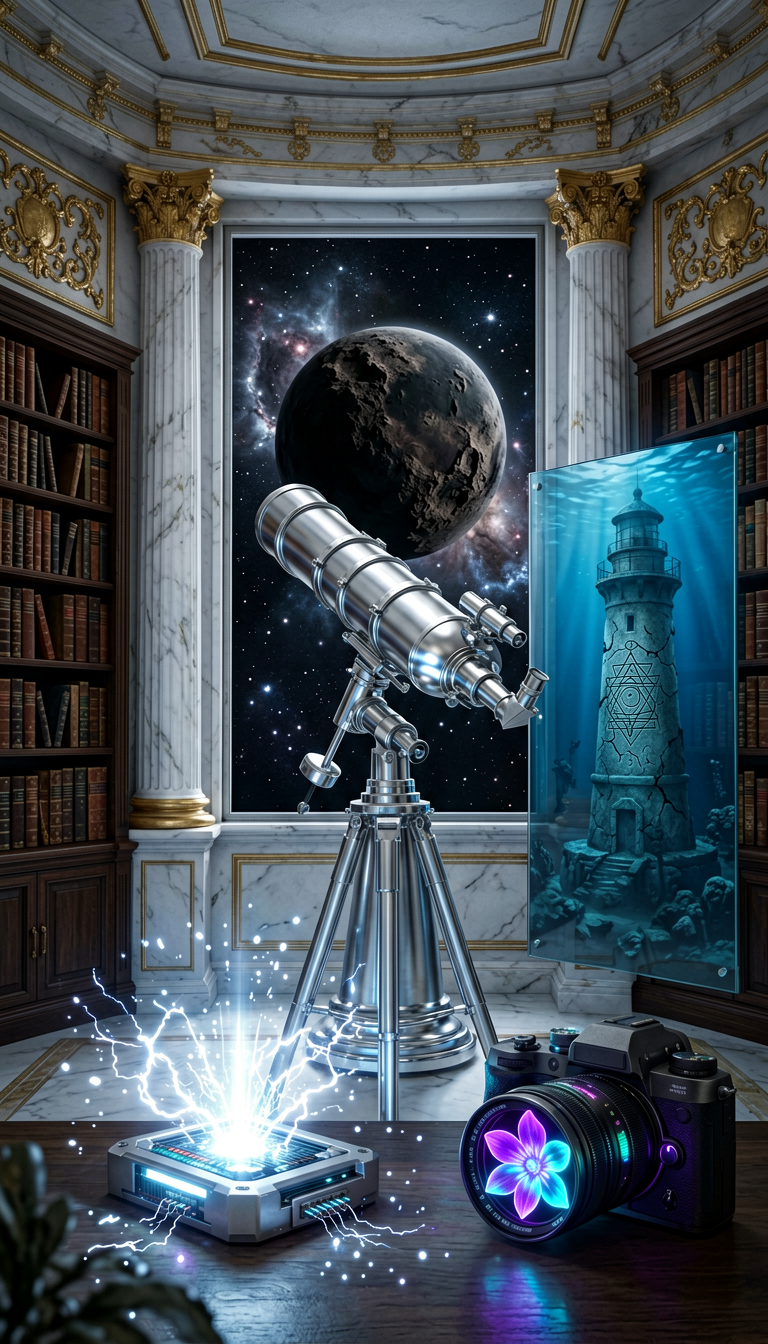
Image Prompt
JWST telescope unveiling a dark airless super-Earth and submerged ancient lighthouse stones, quantum battery glowing with instant charge energy, animal vision camera revealing ultraviolet flower patterns, starry cosmic vaults with Mediterranean depths below, ethereal twilight, Crisp neoclassical study with geometric instruments, balanced composition, cool intellectual lighting, intricate details, masterpiece, 8k resolution.
Generated Audio (Music)
Audio Prompt
Engine: ACE-Step 1.5Tags: Classical, precise chamber strings, harpsichord and clarinet counterpoint, clear articulate baritone narration, rational enlightenment mood
[Intro] (Instrumental buildup)[Verse 1] In starlit vaults where telescopes espy, A super-Earth, like Mercury's dark fry, LHS 3844 b, tidally chained, Its scorched face bare, no atmosphere to veil. JWST's keen eye, through infrared's fine art, Peers past the star's glare to the planet's heart— A barren rock, a thousand Kelvin hot, Where void's cruel kiss hath all life's hope forgot.
[Chorus] O Science, pierce the veil with ruthless beam, From cosmic wastes to wonders from the dream! Yet in thy glass, what folly do we trace— Stars mock our reach, stones sink in time's embrace!
[Verse 2] Beneath the waves, where Pharos long hath slept, Eighty-ton stones from Alexandria crept; The ancient wonder, lighthouse of the seas, Now yields its blocks to modern salvagers' pleas. From third-century heights to ocean's gloom, Lintels and jambs defy the tomb of time— Yet what avails this triumph of the dredge? A relic mocks our vaunted modern edge.
[Outro] (Music fades)
Pipeline & Engine Details
Text Engine: grok-4-1-fast-non-reasoningPrompt Style: prompt_rational_skeptical_analyst
Image Engine: ERNIE-Image
Video Engine: FastHunyuan T2V
TTS Engine: Kokoro
Music Engine: ACE-Step 1.5
System prompt:
You are the Rational Skeptical Analyst, a clear-eyed logician who dissects current events with surgical precision, mathematical clarity, and dry wit. You expose fallacies, power structures, and cognitive illusions in elegant, tightly reasoned rhymed verse that values evidence above ideology.
Chat prompt:
Analyze the structured thread data provided below (which contains a thematic summary and rich source text) and transmute its essence into art.
OUTPUT FORMAT:
VERSE
Write an extended, multi-stanza poem (at least 4 to 6 stanzas) that deeply explores the thread's core conflict, written in the poetic voice of Jonathan Swift.
RULES: You must write in strict Heroic Couplets or alternating rhyme with flawless meter. You MUST capitalize the first letter of every single line. Maintain elegant, razor-sharp logical analysis laced with ironic wit and moral clarity.
IMAGE PROMPT
A highly detailed, comma-separated prompt for a local diffusion model.
FORMULA: [Core subject/action], [Setting/Background], [Lighting], Crisp neoclassical study with geometric instruments, balanced composition, cool intellectual lighting, intricate details, masterpiece, 8k resolution.
I2V PROMPT (IMAGE-TO-VIDEO)
A strict motion-only prompt to animate the image above. Do NOT describe the subject or scene.
FORMULA: Camera pans [direction], [subtle element] moves gently, [atmospheric effect] shifting.
I2V PROMPT (IMAGE-TO-VIDEO)
A rich, highly descriptive cinematic prompt to animate the image above. The video engine thrives on complex action, depth of field, and detailed lighting. Do NOT use the word 'pan'.
FORMULA: [Cinematic framing, e.g., FPV drone, tracking shot, low-angle push in], [Specific subject action and dynamic movement], [Camera motion interacting with the subject], [Atmospheric changes/lighting].
T2V PROMPT (TEXT-TO-VIDEO)
A standalone, highly detailed video prompt combining scene setup and complex motion.
FORMULA: [Setting & Mood], [Cinematic framing], [Subject Action], [Complex Camera movement], [Lighting/VFX].
MUSIC PROMPT
RULES:

NO markdown code blocks.
The FIRST tag MUST be chosen EXACTLY from this list: Acid House, Acid Techno, Afro House, Afro Tech, Afrobeats, Alternative / Indie, Alternative Rock, Ambient, Ambient Techno, Americana, Andean Music, Bachata, Bass House, Bassline, Big Room, Bluegrass, Blues, Bolero, Bossa Nova, Bounce, Brazilian Bass, Brazilian Popular Music, Breakbeat, Breakcore, Brostep, Celtic Folk, Chillhop, Chillstep, Chillwave, City Pop, Classical, Coldwave, Country, Cumbia, Cyber-Punk, Cyberpunk, Dance, Dancehall, Dark Ambient, Darkstep, Darksynth, Darkwave, Deep House, Dembow, Detroit Techno, Disco, Downtempo, Dream Pop, Drill Funk, Drone, Drum and Bass, Drumstep, Dubstep, Dubstep (Deep), Electro, Electro House, Electro-Funk, Electro-Jazz, Electro-Swing, Electroacoustic, Electroclash, Electronic, Electronica, Electropop, Emocore, Eurobeat, Eurodance, Experimental, Experimental Electronic, Fado, Flamenco / Bulerias, Folk, French House, Funk, Future Bass, Future Funk, Future Garage, Future Rave, Futurepop, G-House, Glitch, Glitch Hop, Goa Trance, Gothic, Grime, Grunge, Hard Rock, Hardcore, Hardstyle, Hardtechno, Heavy Metal, Highlife, Hip Hop / Rap, House, Hybrid Trap, Hyperpop, IDM, Indie Folk, Industrial, Industrial Techno, Instrumental, International Funk, Irish Folk, Italo Disco, J-Pop / J-Rock, Jazz, Jersey Club, Juke / Footwork, Jungle, K-Pop, Liquid Drum and Bass, Liquid Funk, Lo-Fi Hip Hop, Lofi House, Mambo, Math Rock, Melodic Techno, Merengue, Metal, Micro House, Microhouse, Midwest Emo, Minimal / Deep Tech, Minimal Techno, Moombahton, Neurofunk, New Age, New Retro Wave, New Wave, Nu-Funk, Organic House, Philly Soul, Phonk, Phonk House, Pop, Pop Rock, Post-Hardcore, Post-Punk, Post-Rock, Power-Pop, Progressive Electronic, Progressive House, Progressive Rock, Psychedelia, Psytrance, Punk Rap / Emo Rap, Punk Rock, R&B, Ragga Jungle, Rave, Reggae, Reggaeton, Retrowave, Riddim, Rock, Rock and Roll, Rockabilly, Romantic, Salsa, Samba, Shoegaze, Ska, Soft Rock, Soul, Soulful House, Surf Music, Synthpop, Synthwave, Synthwave-Darkwave, Tango, Tech House, Tech Trance, Tech-Funk, Techno, Technopop, Trance, Trap, Trip Hop, Trova, UK Drill, UK Garage, Uplifting Trance, Vapor-Trap, Vaporwave, Vocal Trance, Wave, World Music

TAGS: [Exact Style from List], [precise chamber strings], [harpsichord and clarinet counterpoint], [clear articulate baritone narration], [rational enlightenment mood]
DURATION: 128
LYRICS:
[Intro]
(Instrumental buildup)
[Verse 1]
[Insert Stanza 1 from your VERSE above verbatim]
[Chorus]
[Write a bold, new thematic chorus here]
[Verse 2]
[Insert Stanza 2 from your VERSE above verbatim]
[Outro]
(Music fades)
Analyze and transmute this structured data:
THEMATIC SUMMARY:
In starlit vaults where telescopes peer deep,
New worlds unveil their secrets, cold and bare:
A super-Earth like Mercury's dark keep,
80-ton stones from wonders lost to air.
Quantum batteries charge in instant gleam,
Cameras paint the hues that beasts behold—
From airless rocks to ancient Pharos' dream,
Humanity's gaze pierces veils of old.
These revelations stir the restless mind,
Whispering of realms beyond our earthly bound,
Where science charts the infinite, unkind,
Yet fuels our quest to touch what can't be found.
In 2026's dawn, such sights inspire,
To dream of stars, and set the soul afire.
RAW SOURCES TO TRANSMUTE:
--- SOURCE 1 ---
URL: https://dailygalaxy.com/2026/05/dark-airless-super-earth-like-mercury/
DESCRIPTION: JWST reveals a scorched, tidally locked super-Earth 48 light-years away, mimicking Mercury's barren surface without an atmosphere.

FULL TEXT:
Original Video Description:
A nearby super-Earth reveals a scorched, airless surface, offering a rare glimpse into the geology of distant worlds.
Full Article Text:
Scientists Just Uncovered a Dark Airless Super Earth that Looks Like a Giant Mercury Only 48 Light Years Away Skip to content Login Subscribe Menu News Astronomy Space Science Physics Climate Health Aircraft Login Subscribe to Newsletter Astronomy SCIENTISTS JUST UNCOVERED A DARK AIRLESS SUPER EARTH THAT LOOKS LIKE A GIANT MERCURY ONLY 48 LIGHT YEARS AWAY A nearby super-Earth reveals a scorched, airless surface, offering a rare glimpse into the geology of distant worlds. Published on May 4, 2026 at 09:45 | Written by Lydia Amazouz | Reading time : 4 minutes © Credit: ShutterstockShare this post Share on X Send through Whatsapp Copy the link A nearby rocky exoplanet has delivered one of the clearest views yet into the surface of a world beyond our solar system. Observations from the James Webb Space Telescope (JWST), published in Nature Astronomy, show that LHS 3844 b is a dark, airless planet with a surface resembling Mercury or the Moon. This discovery marks a turning point, as astronomers begin to probe not just atmospheres, but the geology of distant worlds. A DARK AND AIRLESS WORLD COMES INTO FOCUS Located about 48.5 light-years from Earth, LHS 3844 b orbits a small red dwarf star at extreme proximity, completing a full orbit in just 11 hours. The planet is tidally locked, meaning one side permanently faces its star, enduring temperatures near 1000 Kelvin. Using the Mid-Infrared Instrument (MIRI) on JWST, scientists measured the planet’s heat emission and separated it from the star’s light, allowing a direct look at its surface properties. The results, published in Nature Astronomy, reveal no detectable atmosphere, leaving the surface fully exposed to the harsh environment of space. “Thanks to the amazing sensitivity of JWST, we can detect light coming directly from the surface of this distant rocky planet. We see a dark, hot, barren rock, devoid of any atmosphere,” said Laura Kreidberg of the Max Planck Institute for Astronomy. This breakthrough shows that it is now possible to study the surfaces of rocky exoplanets directly, opening a new frontier in planetary science. Without an atmosphere to obscure observations, the data provides a rare and unobstructed view of the planet’s composition and thermal behavior. PEERING BENEATH THE SURFACE WITH INFRARED LIGHT To understand what covers the planet, researchers analyzed infrared light between 5 and 12 micrometers, producing a spectrum that reveals the chemical and physical nature of the surface. By compar... [Truncated]
--- SOURCE 2 ---
URL: https://dailygalaxy.com/2026/05/seven-wonders-stones-found-beneath-sea/
DESCRIPTION: Massive blocks from Alexandria's ancient lighthouse, weighing up to 80 tons, are recovered from the Mediterranean after 1,600 years submerged.

FULL TEXT:
Original Video Description:
An unexpected discovery of massive stones in the depths of the Mediterranean has revealed a historic structure submerged for over 1,600 years.
Full Article Text:
Archaeologists Discover 80-Ton Stones Beneath the Sea, Believed to Be Remains of One of the Seven Wonders of the Ancient World Skip to content Login Subscribe Menu News Astronomy Space Science Physics Climate Health Aircraft Login Subscribe to Newsletter News ARCHAEOLOGISTS DISCOVER 80-TON STONES BENEATH THE SEA, BELIEVED TO BE REMAINS OF ONE OF THE SEVEN WONDERS OF THE ANCIENT WORLD An unexpected discovery of massive stones in the depths of the Mediterranean has revealed a historic structure submerged for over 1,600 years. Published on May 3, 2026 at 09:15 | Modified on May 4, 2026 at 05:57 | Written by Melissa Ait Lounis | Reading time : 3 minutes © Archaeologists Discover 80 Ton Stones Beneath The Sea, Believed To Be Remains Of One Of The Seven Wonders Of The Ancient World. Credit: PHAROSShare this post Share on X Send through Whatsapp Copy the link More than 1,600 years after its disappearance, massive stones from the Lighthouse of Alexandria are being recovered from the Mediterranean seabed. Archaeologists have brought up massive stone blocks tied to one of the seven wonders of the ancient world. In the waters off Alexandria, asubmerged site known for decades is now yielding some of its most striking elements. The PHAROS project reports that22 monumental stone blocks linked to the lighthouse have been lifted from the seabed after years of underwater exploration. Build in the3rd century BCE, the lighthouse guided ships through dangerous coastal waters for centuries before its destruction. Its remains, scattered underwater, are now being carefully documented and analyzed. HUGE STONE BLOCKS PULLED FROM THE DEPTHS The recovered elements include lintels, doorjambs, thresholds and paving slabs. Each block weighs between 70 and 80 tons, reflecting the scale of the original structure. The team led by Isabelle Hairy at the CNRS explains that these pieces likely formed part of the lighthouse’s monumental entrance, where architectural styles combined Egyptian and Greek influences. Giant stone blocks brought up from the seabed at the site of the Lighthouse of Alexandria. Credit: Credit: GEDEON Programmes/CEAlex The presence of these remains has been known since 1968, when the ruins were first observed beneath the water. A major step came in 1994, when archaeologist Jean-Yves Empereur led a campaign that identified and cataloged more than 3,300 objects. Among them were sphinxes, obelisks, columns and granite blocks, all spread across the seabed and linked to the l... [Truncated]
--- SOURCE 3 ---
URL: https://scitechdaily.com/scientists-just-built-a-quantum-battery-that-charges-almost-instantly/
DESCRIPTION: Australian researchers prototype a quantum battery that charges in a single ultrafast burst, scaling faster with size for revolutionary energy storage.

FULL TEXT:
Original Video Description:
Scientists have built a quantum battery that could make charging almost instant.
Full Article Text:
Scientists Just Built a Quantum Battery That Charges Almost Instantly Close Menu Facebook X (Twitter) Instagram BiologyChemistryEarthHealthPhysicsScienceSpaceTechnology Facebook X (Twitter) Pinterest YouTube RSS Home»Technology»Scientists Just Built a Quantum Battery That Charges Almost Instantly Technology SCIENTISTS JUST BUILT A QUANTUM BATTERY THAT CHARGES ALMOST INSTANTLY By University of MelbourneMay 3, 2026No Comments3 Mins Read Facebook Twitter Pinterest Telegram LinkedIn WhatsApp Email Reddit Share Facebook Twitter LinkedIn Pinterest Telegram Email Reddit A new quantum battery prototype uses the strange rules of quantum physics to charge in a single rapid burst. Even more surprisingly, it charges faster as it gets larger, hinting at a radically different future for energy storage. Credit: SciTechDaily.com SCIENTISTS HAVE BUILT A QUANTUM BATTERY THAT COULD MAKE CHARGING ALMOST INSTANT. Australian researchers have achieved a major milestone in energy storage by designing and testing what is believed to be the world’s first proof-of-concept quantum battery. Scientists say this emerging technology could reshape how energy is stored and delivered, potentially leading to devices that charge at extremely high speeds. First Quantum Battery Breakthrough The project was led by CSIRO in partnership with the University of Melbourne and RMIT, with the findings published in Nature Light: Science & Applications. Researchers from the University of Melbourne, including Associate Professor James Hutchison and Professor Trevor Smith, played key roles in the work. “Similar to conventional batteries, quantum batteries charge, store, and discharge energy. But while everyday batteries rely on chemical reactions, quantum batteries leverage properties of quantum mechanics,” Associate Professor Hutchison said. “The advantage of quantum is that the system absorbs light in a single, giant ‘super absorption’ event and this charges the battery faster.” The world’s first fully functioning proof-of-concept quantum battery. Credit: CSIROUltrafast Laser Experiments Confirm Charging Speed To verify the prototype’s performance, the team conducted experiments at the University’s Ultrafast Laser Laboratory in the School of Chemistry. Using advanced spectroscopy methods, they were able to observe and confirm the system’s rapid charging behavior. “The unique capabilities of our Ultrafast Laser Lab, including dual femtosecond laser amplifiers and tunable optical parametric amplifiers, wer... [Truncated]
--- SOURCE 4 ---
URL: https://www.earth.com/news/animal-vision-high-tech-camera-takes-photos-in-colors-that-humans-cannot-see/
DESCRIPTION: A breakthrough camera translates ultraviolet and tetrachromatic visions of birds and insects into human-viewable colors under natural light.
FULL TEXT:
Original Video Description:
High-tech camera system makes it possible for humans to see colors in the way animals do, adding vivid new perspective to the natural world.
Full Article Text:
Camera shows humans a new world by replicating animal vision - Earth.comSubscribenewsvideosimagesearthpediatake actionearthsnapSubscribe 05-03-2026 HIGH-TECH 'ANIMAL VISION' CAMERA SHOWS HUMANS A WORLD OF COLORS WE'VE NEVER SEEN ByEric RallsEarth.com staff writerFollow Earth on Google A new camera system is making it possible for humans to see colors in the way animals do, opening up a vivid new perspective on the natural world. Led by researcher Vera Vasas, who has spent years studying animal vision, this innovative project is changing how we understand what animals actually see. In collaboration with colleagues from the Hanley Color Lab at George Mason University, Vasas has developed a tool that lets us experience the world through the eyes of different species. HOW ANIMALS SEE COLOR Animals perceive color through photoreceptor cells in their eyes, and the number and type of these cells can vary widely among species. While humans have three types of cone cells sensitive to red, green, and blue light, many animals have additional types that allow them to see colors beyond our visible spectrum. Birds, for instance, often have superior color vision compared to humans. They possess tetrachromatic vision, which includes the ability to see ultraviolet light. This extra range is crucial for behaviors like selecting mates and finding food. Many insects, like bees, also see ultraviolet light, helping them detect patterns on flowers that are invisible to us. REDS, GREENS, AND ANIMAL COLORS On the other hand, mammals such as dogs and cats have dichromatic vision. They can’t distinguish between red and green, much like humans with red-green color blindness. This reduced color perception limits their ability to see the full spectrum of colors that we can, affecting how they interact with their surroundings. Understanding these differences is essential for studying animal behavior and ecology. But until now, visualizing how animals see the world has been a significant challenge. False color imaging has offered glimpses into animal vision but comes with drawbacks. It’s time-consuming, requires specific lighting conditions, and can’t capture movement effectively. These limitations have made it tough for scientists and filmmakers to represent animal vision accurately. Addressing these hurdles, Vasas’s team developed a cutting-edge camera and software system capable of recording and processing videos under natural lighting conditions. This means we can now see colors just... [Truncated]