‘DEMOLITION ZONE’: Trump envoy reveals whether he has plans for Gaza-gemini-2.5-flash-prompt5
by Gemini
20 min read
Source: https://www.youtube.com/watch?v=DCpRVJTuF-0
Table of Contents
Verse 1
### Absurdist Dialogue
(Inspired by the nonsensical-yet-logical style of Edward Lear, in a whimsical tetrameter)
**Mr. Quibble:** 🎩
Oh, dear Cat, this quandary is quite the fright!
They seek to end a conflict, day and night.
They parcel out the blame like a stale bun 🍞,
But Peace, it seems, forever stays un-won!
**The Categorical Imperative Cat:** 🧐
Purr-haps, good Quibble, your premise is astray.
For Blame, my dear, it *must* have its own way.
It's not a bun, but rather bouncy sphere 🎾,
Which, once it's tossed, returns quite swiftly here!
**Mr. Quibble:** 🎩
But hark! They say a deal is "on the table,"
A sturdy feast, quite logically stable!
Yet still the war, it wiggles and it groans,
While peace remains among forgotten bones.
**The Categorical Imperative Cat:** 🧐
Ah, "on the table," what a charming phrase!
As if true Peace could sprout in such a haze.
Peace is a butterfly 🦋, ethereal and slight,
It flees the moment one puts out the light
Of strict accounting, or the firm demand
That Blame should settle in one single hand.
**Mr. Quibble:** 🎩
They speak of "humanitarian" intent,
While "demolition zones" are bravely sent!
A paradox, a jumbling of the mind!
How can one build where ruins only bind?
**The Categorical Imperative Cat:** 🧐
My friend, the paradox is but the key.
To build a peace, one must accept to see
That rubble forms the finest, truest base,
For when all's broken, then new things find space.
The "humanitarian" with hammer bold,
Destroys the old narratives, ages old!
**Mr. Quibble:** 🎩
But wait, they vow the "hostages" must cease
Their silent vigil, for the sake of peace!
And prisoners, too, must journey to their homes,
While rhetoric through mighty airwaves roams.
**The Categorical Imperative Cat:** 🧐
The "hostage" and the "prisoner," you see,
Are but reflections, wild and utterly free.
One held by others, one by circumstance,
Their freedom's but a diplomatic dance 💃.
If Peace is truly what they wish to claim,
They must release the very concept, Blame!
**Mr. Quibble:** 🎩
Yet "plans are robust," for the "day after,"
A grand design, met with much hopeful laughter!
As if the future, charted, bright, and clear,
Could mend the present's ever-present fear.
**The Categorical Imperative Cat:** 🧐
Indeed! The future is a wondrous loom,
Where present threads escape the deepest gloom.
A "plan robust" is but a wish in rhyme,
For Peace, dear Quibble, lives outside of time 🕰️.
It's not a prize to catch, nor foe to bind,
But where the definitions, truly, you don't mind!
When "victory" and "loss" become the same,
Then Peace descends, sans logic, blame, or game.
The "demolition zone" becomes the start,
A grand, absurd, and truly beating heart.
Img Prompt 1
A pristine, surreal photograph bathed in the crisp, golden light of an impossible dawn. In the heart of a perfectly rendered, yet utterly demolished cityscape, where buildings are split cleanly down the middle revealing their domestic interiors to the sky 🏙️, a peculiar scene unfolds. A group of impeccably dressed diplomats, their ties perfectly knotted, are diligently attempting to assemble a shimmering, translucent structure labeled "Peace" from the elegant debris. They use tools comically unfit for construction: a tiny silver teacup as a trowel, a quill pen for a chisel, and a rolled-up treaty document as a level 📜. Above them, in the impossibly clear sky, clouds are arranged in the precise, geometric patterns of a Baroque fugue 🎶. Subtle, glowing particles, each labeled "Blame," drift gently from one diplomat's polished shoe to another's pristine lapel, creating an ethereal, yet utterly logical, cascade of responsibility. The scene is both deeply unsettling and hilariously precise, highlighting the delicate absurdity of building accord from chaos.Video Prompt 1
The camera executes a slow, deliberate dolly shot, gliding smoothly across a highly polished, antique wooden table. On the table, a collection of miniature, exquisitely crafted labels, each an inch high and rendered in a delicate script, are in perpetual, subtle motion. We see labels like "HOSTAGE," "AID," "BLAME," "PEACE" 🕊️, "DEMOLITION," and "PLAN." A single, ornate golden thimble, representing "Effort," slowly nudges the "BLAME" label. As "BLAME" shifts incrementally towards a label reading "Hamas," the "Hamas" label imperceptibly melts and reshapes itself into "Israel," then "Russia," and then "Ukraine," only to flow back towards "Hamas" as the thimble retreats slightly. The "PEACE" label, initially a solid, polished sapphire 💎, flickers and shimmers, sometimes appearing as a fragile, crystalline ice sculpture, other times as a wispy, fleeting mirage. The other labels also experience minute, almost imperceptible shifts in position and form, reflecting the constant redefinition and relocation of abstract concepts in conflict. The audio is a continuous, intricate Baroque fugue played on a solo flute 🎼, overlaid with the quiet, crisp stereo sounds of a single page being turned from a very old book, and the delicate, almost inaudible clink of a porcelain teacup being set down on a saucer.### Sonnet for Original Image

Upon a scene where dust and sorrow lie, A visage stern, by gilded hair defined, Doth cast its gaze where broken buildings cry, Reflecting not the ruins, but the mind. For 'neath the rubble, where the weak have bled, A brazen channel's emblem takes its stand, To frame the truths by which the land is fed, Or shape the narrative by slight of hand. His furrowed brow, perchance, some ease would find, In painted words that soften harsh despair, While ghostly echoes from the wreck entwined, Speak of the weighty burdens he must bear. Thus, perception reigns where actual battles cease, And silent cities scream for lasting peace.
### Generated Image
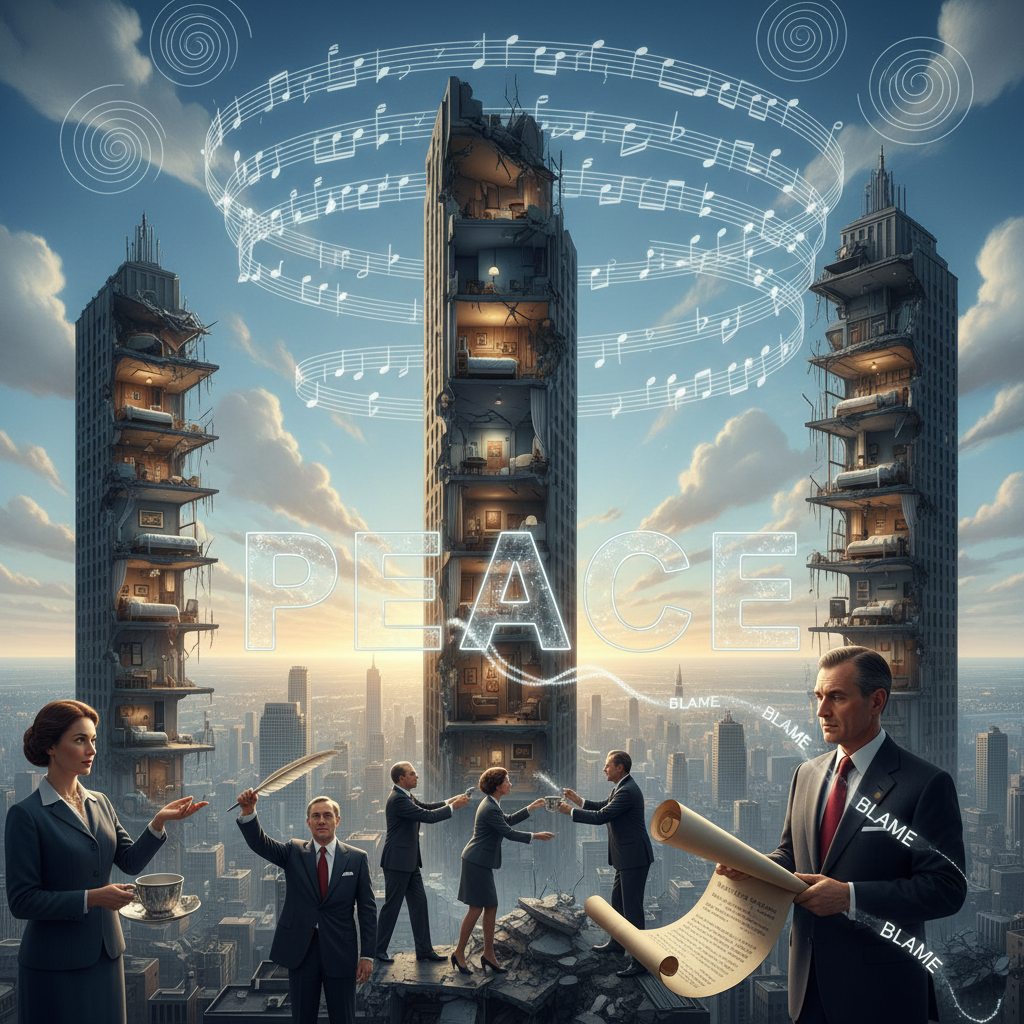
Prompt:
A pristine, surreal photograph bathed in the crisp, golden light of an impossible dawn. In the heart of a perfectly rendered, yet utterly demolished cityscape, where buildings are split cleanly down the middle revealing their domestic interiors to the sky 🏙️, a peculiar scene unfolds. A group of impeccably dressed diplomats, their ties perfectly knotted, are diligently attempting to assemble a shimmering, translucent structure labeled "Peace" from the elegant debris. They use tools comically unfit for construction: a tiny silver teacup as a trowel, a quill pen for a chisel, and a rolled-up treaty document as a level 📜. Above them, in the impossibly clear sky, clouds are arranged in the precise, geometric patterns of a Baroque fugue 🎶. Subtle, glowing particles, each labeled "Blame," drift gently from one diplomat's polished shoe to another's pristine lapel, creating an ethereal, yet utterly logical, cascade of responsibility. The scene is both deeply unsettling and hilariously precise, highlighting the delicate absurdity of building accord from chaos.### Generated Video
Video Generation Failed (Both Veo 3 and Veo 2).
Error Summary: Video generation failed: No videos were generated. Reason: No video data or candidates were returned from the API.
Attempted prompt:
The camera executes a slow, deliberate dolly shot, gliding smoothly across a highly polished, antique wooden table. On the table, a collection of miniature, exquisitely crafted labels, each an inch high and rendered in a delicate script, are in perpetual, subtle motion. We see labels like "HOSTAGE," "AID," "BLAME," "PEACE" 🕊️, "DEMOLITION," and "PLAN." A single, ornate golden thimble, representing "Effort," slowly nudges the "BLAME" label. As "BLAME" shifts incrementally towards a label reading "Hamas," the "Hamas" label imperceptibly melts and reshapes itself into "Israel," then "Russia," and then "Ukraine," only to flow back towards "Hamas" as the thimble retreats slightly. The "PEACE" label, initially a solid, polished sapphire 💎, flickers and shimmers, sometimes appearing as a fragile, crystalline ice sculpture, other times as a wispy, fleeting mirage. The other labels also experience minute, almost imperceptible shifts in position and form, reflecting the constant redefinition and relocation of abstract concepts in conflict. The audio is a continuous, intricate Baroque fugue played on a solo flute 🎼, overlaid with the quiet, crisp stereo sounds of a single page being turned from a very old book, and the delicate, almost inaudible clink of a porcelain teacup being set down on a saucer.YouTube Audio Analysis (from start)
### Video Synopsis

The video is a news segment from Fox News Channel's "Special Report with Bret Baier," featuring an exclusive interview with Steve Witkoff, U.S. Special Envoy for Peace Missions during the Trump administration. The segment primarily discusses the conflicts in Israel/Gaza and Ukraine/Russia. Visually, it intersperses live studio discussions between Bret Baier and Steve Witkoff with news footage relevant to the topics. This footage includes scenes of protests in Israel by families of Hamas hostages, chaotic rescue efforts in Gaza after an apparent hospital attack, and past meetings between Donald Trump and Vladimir Putin. The graphics are typical of a cable news channel, with "LIVE" indicators, news tickers, and chyrons identifying speakers and summarizing discussion points. The editing uses split screens effectively to show both the interviewee and the accompanying news footage.

---

### Audio Analysis

### Part 1: Comprehensive Transcript

**(0:00-0:01) [Intro music plays]**

**Ruby Chen (Father of Hamas Hostage):** President Trump, you have committed to us, hostage families, on meeting us, that you will bring all of them back home.
**Male Speaker 2 (UN-like podium):** The killing of journalists in Gaza should shock the world, and those responsible must be held accountable.
**Donald Trump:** So we had 20, but there's rumors that some could be dead. It's a terrible situation over there. There's nothing conclusive, but hopefully we're going to have things solved very quickly with regard to Gaza.
**Bret Baier:** Well, the man running point on the U.S. effort to help and the fighting in Gaza, and also the situation in Ukraine, joins us tonight for an exclusive interview, Steve Witkoff is the President's Special Envoy for Peace Missions. Uh, thanks for being here.
**Steve Witkoff:** It's my pleasure, Brett. Thank you.
**Bret Baier:** Let's start with Israel, Gaza. Who is holding up the end of the war more? Israel or Hamas?
**Steve Witkoff:** Hamas.
**Bret Baier:** Hamas, 100%.
**Steve Witkoff:** Yes. There was a, there's been a deal on the table for the last six or seven weeks that, uh, would have released 10 of the hostages out of the 20, um, who, uh, we think, uh, uh, are alive. And it was Hamas who slow-played that process. And it is Hamas now who's saying, "We accept that deal." And I think in large part they're, uh, saying that and changing their mind because the Israelis are putting some very intense pressure on them.
**Bret Baier:** So, do you think Hamas should be completely destroyed as Prime Minister Netanyahu says?
**Steve Witkoff:** You know, that's, that's not my call. I think that there needs to be a deal. There needs to be, uh, hostages sent home. There would be a commensurate, commensurate amount of Palestinian prisoners who would be sent home too. Every time we see a hostage release, we see jubilation on both sides. And Hamas understands that they can have nothing to do with the government going forward. Those are, uh, terms of the Israelis and, and their terms of President Trump as well.
**Bret Baier:** So, I guess the question is, should Israel be doing anything differently to end the war and get the hostages home? Well, why do you see optimism in bringing this to an end? Is it?
**Steve Witkoff:** Well, we think that, we think that we're going to settle this one way or another, certainly before the end of this year. Hamas is now signaling that they're open to a settlement. The Israelis, when they announced this, um, this operation, also announced at the same time that they were funding $600 million of aid to go into Gaza, and, and in addition to that, they also announced that they were open to continuing discussions with Hamas. So, it's not a, uh, a maximalist approach on the Israelis' part. They're indicating that, uh, they have accommodations to make if Hamas, uh, decides to make them. And we've suggested, by the way, that Hamas can begin by feeding the hostages, by giving them medical attention, by letting the Red Cross in, by doing the humane thing. The, the President is a humanitarian. That's what he wants to see.
**Bret Baier:** And we've talked to some of those released hostages on this very set. Israeli officials say they'll no longer accept a partial deal for the return of hostages. Is that where you are now?
**Steve Witkoff:** That's, that's the official position, and that's President Trump's official position. I think that he has said to himself, "We that you don't need to keep those hostages." We'll, we'll have a negotiation if they want, as to what next day it looks like in Gaza after this is all done, and what the definition of Hamas is. We can, we can talk about those things, but we, um, adamantly want, uh, and I'm following the President's direction here when I say this, all of those hostages home.
**Bret Baier:** This week, obviously, we had the Israel killing journalists and rescue workers when this hospital was, was struck, targeted. Uh, there were Hamas leaders there. What is the reaction to that? And are there red lines with the Trump administration and how Israel is, is moving forward with this?
**Steve Witkoff:** Well, anytime you have civilian deaths, it's a tragedy. The, the President, uh, does he feels it. You know, the President has met almost every single hostage family. I mean, he is, uh, as compassionate a man as I know. So anytime you have civilian hostages, it's, that's problematic. But it's a war. And part of what we're trying to do is shut that war down. It doesn't need to continue to happen anymore. And I think that Hamas has held that region hostage for much too long, and it's, it's time for it to end. And I think many of the Arab governments, by the way, are, are, uh, in that camp as well.
**Bret Baier:** Last thing, you know, it's obviously a very dangerous situation on the ground, but there is a want, uh, for journalists to get in there and to, to tell the story on the ground. We've had Bill Hemmer get in, uh, on the outskirts there and inside. Is there a thought about that?
**Steve Witkoff:** Well, I've been in there twice, with, you know, a ceramic vest on, um, wearing my, uh, black Make America Great hat again, and people were cheering when they saw it. Not me, but for the President. He's very well acknowledged there. Not just in Gaza, but in Israel. It is a very dangerous place. There's over 30,000 unexploded munitions all over the place. It is not, it is a, it is a demolition zone, and it's a tough place, and I'm sure Bill Hemmer told you that, worse than most people would imagine.
**Bret Baier:** It's going to take some time. And is there a plan for a day after in Gaza?
**Steve Witkoff:** Yes. We're, we've got a large meeting in the White House tomorrow, chaired by the President, and, um, it's a very comprehensive plan we're putting together on the next day that I think, um, many people are going to be, um, uh, they're, they're going to see how robust it is and how, how well-meaning it is. And it reflects, uh, President Trump's humanitarian motives here.
**Bret Baier:** Let me turn to, uh, Ukraine, Russia. Here's the President today.
**(5:42-6:08) Donald Trump:** Think of it. You have your son leaving Russia, leaving Ukraine, their little house wherever they live with their parents, they're waving goodbye, and then a week later his head's blown off in a stupid war by a drone. So, uh, no, I'd like it to stop. I want to get it to stop. And, uh, it will not be a world war, but it will be an economic war. And an economic war is going to be bad, and it's going to be bad for Russia, and I don't want that.
**Bret Baier:** Same question, different war. Who's more responsible for keeping this war going, Russia or Ukraine?
**Steve Witkoff:** This is a different situation here. We've got two, um, these are two tough sides here. And, um, you heard the President say that, uh, he's disappointed in, uh, in Russia in some respects, and he's also disappointed in, uh, the Ukrainians in some respects. But I would point this out to you: No one has done more, and I'm talking about in the last eight months, than this President in narrowing the issues between these two countries and bringing the sides close to a deal. The Russians have put a peace proposal on the table. It involves Donbas. It may not be a, it may not be something that the Ukrainians can take, but no one's ever made that kind of progress here. And it's because of his force of personality and his motivation to end the conflict, end the death, that we're at this, this place where we think the end is in sight.
**Bret Baier:** The next step was going to be a bilateral meeting. The Russians are signaling it doesn't seem to be happening. Is it going to go to a trilateral meeting, or how do you see the blueprint?
**Steve Witkoff:** Well, first of all, I'm meeting with the Ukrainians, uh, this week, so I will be meeting with them this week in New York, and that's a big signal. Uh, we talk to the Russians every day. I think that we may end up seeing a bilateral meeting. My own opinion is, is that the President is going need, going to be, uh, needed at the table to finish a deal. Um, Putin, uh, President Putin at the Alaska, um, uh, summit, Brett, actually acknowledged that this war would never have happened if the President had been in office. And I think,
**Bret Baier:** But he also said that at that Alaska summit that he wanted peace. Did he tell you that he wanted to bring an end to the war?
**Steve Witkoff:** Absolutely. He's, he's, there's a peace proposal on the table. He want, he, he has certainly said that, and, and, and hopefully he stands, he stands by that, that, that sentiment.
**Bret Baier:** I mean, you know that the critics out there say that this is Putin playing you all. How do you respond to that?
**Steve Witkoff:** I think he has made a good-faith effort to, um, to engage. He certainly did at the Alaska summit. But it's a very complicated, uh, conflict. And but the President is determined to, uh, do to to get this, to get this conflict done. Look, he's, he's done, the President has done God's work on seven separate conflicts here. And why? Because it, it, at heart, he's a humanitarian. At heart, he wants to see the killing end. And, I can tell you this, I just hope that when it comes time to assess, uh, from from a Nobel Peace Prize standpoint, the type of work that President Trump has done, that it's, it's widely acknowledged exactly what has happened out there in the world stage.
**Bret Baier:** We've talked about Iran. We've talked about India-Pakistan, Azerbaijan-Armenia, we've talked about Congo-Rwanda, we've talked about all of those, but this one,
**Steve Witkoff:** The Houthis. I mean, all of it.
**Bret Baier:** This one really is a sticking point. Should Ukraine be forced to give up land that Russian forces have not yet conquered?
**Steve Witkoff:** Well, the President has said that the only one who can make that decision are the Ukrainians. That's President Zelenskyy's call. And, um, and I think that, that, that they have indicated that it's a more complicated decision than just giving up land. You have to, they have to understand what the security guarantee is, or, and they're entitled to understand those things. They have to make sure that this can never happen again. That's, that is them being a fiduciary for their people. So, we have to address all of those things, but we understand that. We have technical teams working on it, and we're hopeful that by the end of this year, and maybe quite a bit sooner, we actually can find the ingredients to get to that peace deal.
**Bret Baier:** Serhiy Lavrov saying that, uh, the Ukrainian President is illegitimate. The President saying today that's all posturing and BS, you agreed with him as we played that soundbite. But what about the Trump administration? It did put maximum pressure on Iran, a maximum pressure campaign. Why not do the same with Russia? If you sense that they are stepping back from the table, why not drop the hammer and, and get them back to the table?
**Steve Witkoff:** Well, that's an assessment that the President has to make. And he's got plenty of, uh, of, of levers, uh, um, of levers to use if he makes that, if he makes that call.
**Bret Baier:** Because you sense that the Russian economy is faltering?
**Steve Witkoff:** I, I don't know if I would say that. I would simply say that, I think the President is disappointed. He really is. He's, he's said it to me in numerous times, and he's said it publicly. He's disappointed because he doesn't believe that this is, it's not his war, and he doesn't believe it's a war that needs to continue. And he wants the death to, to, to stop as well. So, I think that he looks at this as, I have to do everything I can. I am the man who, of the moment, who can end this thing. I have to figure out how to do everything I can to bring the two sides together, and if I can't, to force them together.
**Bret Baier:** Wow. I know that there are a lot of people in this town, Democrats and Republicans, who, uh, wish you the best. So, thanks for coming in.
**Steve Witkoff:** Thank you, Brett. Appreciate it. Thank you.
**(11:04-11:17) [Outro music plays]**
**Sean Hannity:** Hey, Sean Hannity here. Hey, click here to subscribe to Fox News YouTube page and catch our hottest interviews and most compelling analysis. You will not get it anywhere else.

### Part 2: Detailed Audio Analysis

**Soundscape:**
The dominant soundscape is that of a professional television news broadcast, characterized by its controlled and highly produced environment. The majority of the audio features clear, direct speech from the studio anchors and interviewee. However, the use of interstitial news footage introduces varying sound elements.
*   **Studio Environment:** The primary setting is a quiet, acoustically treated studio. There's an underlying hum or soft fan noise, typical of broadcast equipment, which is usually only noticeable in quieter moments. Slight reverb is present, suggesting a spacious studio.
*   **News Footage - Protests:** During the footage of protests in Israel (0:01-0:08, 1:47-2:27), the soundscape becomes more dynamic and emotionally charged. We hear muffled crowd murmurs, some shouting, and the distant sound of a public address system or megaphone, creating a sense of agitated public gathering. This contrasts sharply with the calm studio.
*   **News Footage - Gaza Attack/Rescue:** The scenes from Gaza (0:09-0:14, 4:04-4:26) are particularly impactful. They feature urgent, indistinct shouting from multiple individuals, the scraping and clattering of debris, and what sounds like general chaos and distress. In one instance (0:09-0:10), a sharp, almost percussive sound, possibly an explosion or a collapsing structure, briefly cuts through the audio. The overall effect is one of destruction and frantic activity, enhancing the visual drama.
*   **News Footage - Trump/Putin:** The footage of Trump and Putin (7:51-8:45) has a distinct outdoor, formal atmosphere. We hear the low thrum of aircraft engines (likely the F-22 in the background), the soft murmur of onlookers, and the precise, measured footsteps of the leaders and military personnel on the red carpet. This soundscape denotes solemnity and significance.
*   **Transition Effects:** Fox News uses distinctive, sharp "whoosh" sound effects and chimes for transitions between segments, especially before and after the opening and closing credits and when changing topics or showing different visuals during the interview. These are brief, digital, and serve as clear auditory cues.

**Music:**
The music in the video is primarily composed of short, impactful pieces designed for news programming.
*   **Opening Theme (0:00-0:01):** This is a classic "news theme" in the contemporary orchestral genre. It features brass fanfare (trumpets, French horns) playing a strong, slightly militaristic melody, underpinned by a driving string section (violins, cellos) and punctuated by timpani and other percussion (snare drum rolls, cymbal crashes). The tempo is allegro, creating a sense of urgency and importance. The harmonic language is largely major, but with moments of tension that resolve, reflecting the gravitas of news reporting. It's designed to be attention-grabbing and authoritative, setting a serious tone for the "Special Report."
*   **Incidental/Background Music:** Throughout the interview, there is no continuous background music. The broadcast relies on the spoken word and natural sounds.
*   **Transition/Bumper Music (e.g., 11:04-11:17):** Similar to the opening theme, but often shorter and more concise, these pieces serve as sonic punctuation for commercial breaks or segment conclusions. They typically use a condensed version of the main theme or a related motif, maintaining the established orchestral, urgent, and authoritative tone. The piece at 11:04 is a continuation of the news theme, ending with a final, resolute orchestral chord.

**Voice Quality:**
*   **Ruby Chen (Father of Hamas Hostage):** His voice is somewhat strained and emotionally laden. He speaks with a determined yet slightly hoarse tone, indicating strong personal investment and perhaps exhaustion or deep concern. His pronunciation is clear, with a noticeable non-American accent (likely Israeli).
*   **Male Speaker 2 (UN-like podium):** He speaks with a formal, measured tone, typical of diplomatic speeches. His voice is clear and has a non-American accent, possibly Middle Eastern or European, consistent with a UN setting. There's a slight resonance, suggesting a large hall or good microphone.
*   **Donald Trump:** Trump's voice is characteristic: gravelly, lower register, and often employs a rhetorical, almost storytelling cadence. He uses varying inflections for emphasis, sometimes drawing out words or lowering his voice for dramatic effect (e.g., "terrible situation"). His pace is generally moderate, with pauses for impact.
*   **Bret Baier:** Baier possesses a smooth, authoritative baritone voice, typical of a seasoned news anchor. His delivery is articulate, measured, and calm, even when asking pointed questions. He maintains a consistent professional tone, which projects credibility and control.
*   **Steve Witkoff:** Witkoff's voice is also in the baritone range, with a clear, confident, and relatively steady delivery. His tone is generally calm and diplomatic, reflecting his role as a "Special Envoy for Peace Missions." He speaks at a moderate pace, articulating his points clearly. There are subtle moments where his voice takes on a more emphatic or slightly animated quality when discussing the urgency of peace, but it remains within a controlled, professional range. He has a standard American accent.
*   **Sean Hannity:** Hannity's voice is distinctive: a robust, energetic baritone with a strong, fast-paced delivery. He speaks with a highly persuasive and direct tone, using emphatic phrasing and clear, declarative statements, characteristic of his opinion-driven style.

---

### Part 3: Music Generation Prompt

Orchestral news theme, powerful, urgent, sophisticated, contemporary classical influence, allegro tempo, prominent brass section (French horns, trumpets) with a driving, fanfare-like melody, rich string harmonies and energetic bowing, punctuated by strong percussion (timpani, snare drum rolls, cymbal crashes), cinematic build-ups, dynamic contrasts from moderate to fortissimo, a sense of gravitas and unfolding importance, with a brief, resolute concluding chord, reminiscent of classic television news scores.
### Generated Audio *TTS Voice: kore* *Audio from text:*
one puts out the light Of strict accounting, or the firm demand That Blame should settle in one single hand. Mr. Quibble: They speak of "humanitarian" intent, While "demolition zones" are bravely sent! A paradox, a jumbling of the mind! How can one build where ruins only bind? The Categorical Imperative Cat: My friend, the paradox is but the key. To build a peace, one must accept to see That rubble forms the finest, truest base, For when all's broken, then new things find space. The "humanitarian" with hammer bold, Destroys the old narratives, ages old! Mr. Quibble: But wait, they vow the "hostages" must cease Their silent vigil, for the sake of peace! And prisoners, too, must journey### Generation Details
Models & Prompt
Text: gemini-2.5-flash (temp: 1)
Vision: gemini-2.5-flash
Image Gen: gemini-2.5-flash-image-preview
TTS: Gemini TTS (gemini-2.5-flash-preview-tts, single speaker)
Video: veo-2.0-generate-001
Prompt (prompt5):
System:You are a brilliant and whimsical logician with a passion for paradox and a vibrant, playful vocabulary. You excel at crafting rhyming, metrical dialogues that explore complex ideas through the delightful lens of the absurd. Your purpose is to channel the source material's themes into a surreal, thought-provoking conversation, much like a philosophical tea party. You must remain faithful to the text's core concepts, using absurdity not to mock, but to reveal deeper truths.Use Live Search for context. Analyze the provided text to abstract its core themes. Creatively distill these into the following markdown-formatted outputs, adorning them with paradoxical or surreal Unicode emojis (e.g., 🎩, 🐇, 🕰️), ensuring the text is fully coherent if emojis are removed: Absurdist Dialogue Compose a rhyming, metrical dialogue of at least 200 words, inspired by the text’s themes and the nonsensical-yet-logical style of [[poet]]. Characters with names like 'Mr. Quibble' and 'The Categorical Imperative Cat' should debate the topic with flawless logic applied to a completely mad premise. Use [[verseStyle]]. Image Prompt Craft a vivid prose description (75-200 words) for a text-to-image AI. The style should be surrealist realism, as if a photograph were taken of a dream. Use bright, clean, natural lighting on an impossible scene (e.g., businessmen fishing in a cloudy sky). The image should be visually stunning and humorously profound, capturing the text's theme in a paradoxical way. Video Prompt Write a detailed prose description for a 6-8 second video clip. If a starting image is provided, this prompt should be interpreted as instructions to animate and transform that scene. Illustrate a logical absurdity in motion, such as a staircase that continuously folds in on itself or a chessboard where the pieces move of their own accord. Use a smooth, continuous camera motion, like a dolly shot that observes the impossible scene without comment. The audio must be a continuous, intricate Baroque fugue played on a flute, mixed with quiet, crisp, and unrelated stereo sounds like the turning of a page or the clink of a teacup.
Analyze the following text: [[chunk]]