Bookmarks 2025-10-15T02:45:04.193Z
by Owen Kibel
37 min read
Bookmarks for 2025-10-15T02:45:04.193Z
-
 “They’re Calling It Colossus”: Elon Musk’s New Memphis Megaproject Packs 500,000 AI Chips, Massive Profits—and a Growing Pollution Backlash
Added: Oct 14, 2025
“They’re Calling It Colossus”: Elon Musk’s New Memphis Megaproject Packs 500,000 AI Chips, Massive Profits—and a Growing Pollution Backlash
Added: Oct 14, 2025“They’re Calling It Colossus”: Elon Musk’s New Memphis Megaproject Packs 500,000 AI Chips, Massive Profits—and a Growing Pollution Backlash
Site: Rude Baguette
Elon Musk, a name synonymous with innovation and ambition, is making waves in the artificial intelligence (AI) sector with his latest venture in Memphis,

-
 UK’s most remote pub cancels Harry Potter party after JK Rowling backlash
Added: Oct 14, 2025
UK’s most remote pub cancels Harry Potter party after JK Rowling backlash
Added: Oct 14, 2025UK’s most remote pub cancels Harry Potter party after JK Rowling backlash
The Old Forge at Inverie said its evening of wizardry based on the books by the Scottish author, whose views have angered trans activists, had proved divisive

-
Edit images in Search using Nano Banana with Lens Added: Oct 14, 2025
How to edit images with Nano Banana in Search
Site: Google
Here’s your guide for editing images in Search using Lens with Nano Banana.

-
Interstellar Object 3I/ATLAS Looks Increasingly Weird - YouTube Added: Oct 14, 2025
Interstellar Object 3I/ATLAS Looks Increasingly Weird
Site: YouTube
Check out Brilliant for science courses on your favorite subjects! Start learning for free at https://brilliant.org/sabine/ and get 20% off a premium subscri...

-
Canadian Nobel Prize winner Peter Howitt on building the economy through ‘creative destruction’ - The Globe and Mail Added: Oct 14, 2025
Canadian Nobel Prize winner Peter Howitt on building the economy through ‘creative destruction’
Site: The Globe and Mail
Howitt was jointly awarded half of the Nobel Prize for Economics on Monday, for his work on the way disruption fuels growth

-
Site: X (formerly Twitter)

-
Site: X (formerly Twitter)
-
 The Universe’s “Red Sky Paradox” Just Got Darker — Most Stars Might Never Host Observers | IFLScience
Added: Oct 14, 2025
The Universe’s “Red Sky Paradox” Just Got Darker — Most Stars Might Never Host Observers | IFLScience
Added: Oct 14, 2025The Universe’s “Red Sky Paradox” Just Got Darker: Most Stars Might Never Host Observers
Site: IFLScience
A new study from David Kipping attempts to explain why we are located around a yellow star, and so early in the universe.
A new study has looked into the so-called "red sky paradox" and the puzzling observation that intelligent life has sprung up on Earth so early in the Stelliferous Era of the universe. Analyzing the problems using Bayesian statistics, the suggested solutions are not pretty. The only intelligent life we have observed lives around a G-type main sequence star, sometimes referred to as a yellow dwarf, or just "the Sun". This shouldn't be too surprising. We are around a star that is right for the conditions for life. If these conditions weren't present, we wouldn't be here to observe their inadequacy. But our star is far from the most abundant type in the cosmos. M-dwarfs are far more abundant, representing around 60-70 percent of the stars in our own galaxy, assumed to be broadly similar across the cosmos. This presents what David Kipping, associate professor of astronomy at Columbia University, calls the "red sky paradox". "Most stars in the universe are red dwarfs. They outnumber stars like our Sun by a factor of 5 and outlive them by another factor of 20 (population-weighted mean)," Kipping explained in a 2021 paper. "When combined with recent observations uncovering an abundance of temperate, rocky planets around these diminutive stars, we are faced with an apparent logical contradiction – why do we not see a red dwarf in our sky?" "As a general principle of statistics, a random sample drawn from some unknown distribution is unlikely to be a tail-end outlier," Kipping explains in his new paper, which has not yet been peer reviewed. "This reasoning informs the Copernican Principle, which argues that amongst all observers, our experience is not privileged and should thus be a representative sample; an idea which has become a cornerstone of modern cosmology." And yet here we are around a yellow (well, green ) star. Weirder still, the current star-forming "Stelliferous Period" of the universe is projected to continue for around 10 trillion years. So why are we here in the first 0.1 percent of that time, if we assume we are typical observers? There are a few suggestions for why this is the case, which Kipping analyzed using a Bayesian model. One suggestion is that stars below a certain mass simply do not produce observers, dubbed the "desolate M-dwarf hypothesis". Another, called the "truncated window hypothesis", suggests that the time window for observers can be cut short by planetary-scale problems. A third suggests that it is merely luck. Using Bayesian analysis, Kipping largely dismisses the luck option, with a "Bayes factor of ∼1600". "That is huge. Usually we would say that anything above 10 to one is classified as strong evidence and anything above 100 to one is typically called decisive evidence," Kipping explained in an accompanying Cool Worlds video. "We literally don't have words to describe numbers which are higher than 100 to one. So at 1,600 to one, we really just don't have a leg to stand on." Another idea, that the universe's observers are wiped out by some huge cataclysmic event – such as false vacuum decay, or " grabby aliens " – was suggested by Kipping. However, this was found to be statistically more unlikely than the other available explanations. "Two plausible explanations remain: M-dwarfs do not develop observers and the window for observers is truncated to some maximum timescale," Kipping explains in his discussion. "We have found that the latter is untenable in isolation, rejected at a Bayes factor of ∼33, although it may contribute in collaboration with the desolate M-dwarf hypothesis." The model favored by Kipping, in which habitable lifetimes of planets are set to 10 billion years, unfortunately rules out "all stars with masses below 0.34 [solar masses] as developing observers to 95.45 percent confidence – a cutoff which kills some two-thirds of all stars in the universe." In other words, stars with a mass around a third of our Sun's are unlikely to produce observers. According to this model, though there is some wriggle room, the universe could be pretty desolate. "I think that the solution presented that low mass stars do not develop observers provides by far the best explanation as to our existence," Kipping says in the video, adding that life may still be possible around these lower-mass stars, even if intelligent observers do not emerge. They could, of course, become colonized, as intelligent species expand through the cosmos. "But barring interstellar colonization, M-dwarfs should be very quiet places. That's my best bet. I think it is rigorously the most likely position based on the available data." The study is posted to preprint server arXiv.

-
 Trump Admits He Got Jabbed With Multiple Vaccines That His Allies Say Are Poison
Added: Oct 14, 2025
Trump Admits He Got Jabbed With Multiple Vaccines That His Allies Say Are Poison
Added: Oct 14, 2025Trump Admits He Got Jabbed With Multiple Vaccines That His Allies Say Are Poison
Site: Futurism
US president Donald Trump has received multiple vaccines -- while his allies and appointees continue to rage against them.

-
Calif.'s 'salad bowl' putting locals at risk with pesticide exposure Added: Oct 14, 2025
Calif.'s 'salad bowl' putting locals at risk with pesticide exposure
Site: SFGATE
These chemicals are linked to issues with children's brain development.
Monterey County, part of the “salad bowl of the world,” still has a harmful pesticide problem that could put half of pregnant women in the area at risk. The use of organophosphates — a type of agricultural pesticide linked to adverse impacts on children’s brain development — jumped by 26% from 2016 to 2021 in Monterey County, a recent study found. This was despite the fact that, across California, use of these chemicals dropped after the state banned the most common one — chlorpyrifos — in 2020. Monterey was a major outlier, since only one other county, Santa Barbara, increased use, and only by 4%. “Although organophosphate use went down overall after the ban, and that can offer some public health benefits, those benefits were not experienced equally,” Miriam Rotkin-Ellman, an independent public health researcher and lead author of the study, told SFGATE. “Monterey County is one of the remaining hot spots.” The researchers found that 50.1% of pregnant women in Monterey County who gave birth in 2021 lived within just 1 kilometer of organophosphate application. By comparison, just 7.5% of pregnant women lived that close to the pesticide use statewide. The inequities were stark, with five times as many pregnant people who identified as Hispanic or Latino having this chemical exposure in Monterey, as compared to this same group statewide. In the study, Rotkin-Ellman and her colleagues calculated the change in agricultural organophosphate pesticide application, by weight, between 2016 and 2021. They investigated the spatial and demographic patterns of application within 1 kilometer of residences during pregnancies that corresponded to births statewide in 2021. “Not only is organophosphate use geographically not uniform, but there are also some really marked racial and ethnic disparities, with Hispanic and Latine families experiencing a huge burden,” Rotkin-Ellman said. The authors included researchers from Public Health Institute’s Tracking California and UC Berkeley’s Center for Environmental Research and Community Health. Some of Monterey’s big crops, like lettuce, are labor-intensive — so people live close to the fields — and continue to be major users of organophosphates other than chlorpyrifos, the study reported. By contrast, in the Central Valley, the now-banned chlorpyrifos had dominated the pesticide use on tree nuts and citrus. Organophosphates are neurotoxicants that can lead to muscle spasms, confusion, seizures and even — in extreme cases — death, according to the study. For children, especially those exposed in utero, the study links the pesticides to adverse neurodevelopmental impacts such as reduced IQ, autism, ADHD and cerebral palsy. Following the release of the study, community members and advocates gathered in a demonstration outside the Monterey County Government Center in Salinas at the end of September. Some had a list of demands for regulators, including establishing stronger buffer zones between pesticide use and residential areas, schools and day care centers. They also pushed for expanding environmental monitoring, requiring real-time pesticide use notifications — and phasing out use of organophosphates. “There’s a history behind this kind of environmental racism, where the people that tend to be impacted are most typically people of color — in this case, Latinos and Latinas,” Jacob Sandoval, state director of the California League of United Latin American Citizens, told SFGATE. “What’s alarming is that history has told us that eventually this gets solved, but not until a lot of people get sick or have been impacted by these pesticides.” History | Why a wealthy banker blasted a huge hole in a Bay Area cliffLocal | There's a mansion hidden directly under the Bay BridgeCulture | Inside the Bay Area’s cult-like obsession with Beanie BabiesLocal | The world's last lost tourist thought Maine was San Francisco Get SFGATE's top stories sent to your inbox by signing up for The Daily newsletter here.

-
AI systems and humans ‘see’ the world differently – and that’s why AI images look so garish Added: Oct 14, 2025
AI systems and humans ‘see’ the world differently – and that’s why AI images look so garish
Site: The Conversation
Research asking AI models to describe and generate pictures reveals they see a bright, sensational world of generic images.

-
New Yorkers must save the city of dreams from Mamdani’s socialism Added: Oct 14, 2025
New Yorkers must save the city of dreams from Mamdani’s socialism
Site: The Hill
New York is not ready for his radical experiment.
This isn't an endorsement. None is necessary. Even a third grader can see what's at stake in New York City’s mayoral election. This is now a two-candidate race between Zohran Mamdani (D) and Andrew Cuomo. The opportunity is now. The urgency is real. Curtis Sliwa (R) is probably a decent candidate anywhere else. But this is New York. He's a Republican in a Democratic stronghold, and he doesn't enjoy the support of President Trump — meaning his narrow pathway is closed. Sliwa means well, but he can't win. So we are left with a stark choice, and the stakes could not be higher. New York is about to hand the keys to City Hall to a man whose greatest skill is manipulating algorithms. Mamdani has built a digital propaganda machine that would make any authoritarian proud. He runs on viral moments and manufactured outrage, not results. That might work for influencers, but it's a recipe for disaster when you're running a city of over 8 million people. New York is not ready for his radical experiment. He would dismantle the city's cultural fabric that has taken 250 years to build. Worse, he doesn't have the experience. You can't just go from riding in a plane to flying a 787. He's too young, too raw, and too naïve about what makes this city work. And unlike every mayor before him, he'll never have to face real accountability — his social media army has been trained to attack critics, not question their leader. Mamdani seems like a decent guy, but his policies would raise taxes, make our streets less safe, decimate New York's economic base and drive out businesses. He is on the record as anti-NYPD, a harsh critic of Israel, and he has floated the abolition of private property. He is far too comfortable in the company of antisemites and he won't back away from his own calls, using the language of terrorism, to "globalize the intifada. He is bankrolled by a radical network that doesn't believe in America or the freedoms that made this country great. That's not just bad politics — it's dangerous. Lock your doors, New Yorkers. His proposals — rent freezes, free buses, city-owned groceries, 200,000 new government housing units on top of the New York City Housing Authority’s more than 177,000 — would supposedly be funded by tax hikes on millionaires and corporations. But this will just drive them all to Florida, leaving the bill for the middle class. Mamdani's followers don't understand what the New York City Housing Authority is. They don't understand municipal bonds. They'll vote for revolution because it got 4 million views. Being mayor isn't a Tik Tok video. It means solving real problems: crime, housing, homelessness, jobs. It means managing a budget bigger than that of most states. The state of New York already faces a $3 billion deficit, and our economic base is packing its bags. Viral moments won’t replace serious solutions. By the time his followers realize the rent freeze destroyed housing construction, the algorithm will have moved on. Andrew Cuomo paid his price. Nobody's perfect. He faced the consequences. But he's done the job. He has governed through crises, kept the economy growing and balanced budgets. On housing — the issue New Yorkers care about most — he has unmatched experience: governor, Secretary of Housing and Urban Development, nonprofit housing leader. He has the skills to deliver real solutions, not empty promises. Three times, New Yorkers elected him governor. That matters. You don't have to like or forgive Cuomo, but this is about preventing disaster. You can hold your nose, cast your vote and go back to criticizing him tomorrow. That's how democracy works when the alternative is unthinkable. At some point, Sliwa will likely step aside. But even if he doesn't, the real choice is clear: A proven leader who has navigated crises and delivered results, or a digital demagogue who has built a cult of personality disguised as a movement. And it turns out, more and more New Yorkers are agreeing. Even people who can't stand Cuomo are quietly saying they'll vote for him because the stakes are too high. That's when you know this is real — despite the polls, Cuomo can win. This is urgent. If you are a citizen of this city, this election matters to you. Sober up, look at the facts — just the facts — and use your common sense and get out and vote. Because if you don't, what you'll be left with isn't just bad governance. It's an experiment in viral authoritarianism. By the time the algorithm moves on to the next trend, the damage will be permanent. And what you'll have lost — accountability, institutions, democratic norms — you won't get back for a generation. Earle Mack is a former United States ambassador to Finland.

-
Trump threatens to pull support for Argentina if its politics move leftward
Site: The Hill
WASHINGTON (AP) — President Donald Trump on Tuesday threatened to pull assistance for Argentina — led by a political kindred spirit whose philosophy is similar to that of the Republican administrat…
WASHINGTON (AP) — President Donald Trump on Tuesday threatened to pull assistance for Argentina — led by a political kindred spirit whose philosophy is similar to that of the Republican administration — if the nation’s internal politics don’t align with his interests in upcoming elections. The comments came during a meeting with Argentine President Javier Milei, whose country is set to hold midterm elections for its legislative body later this month. U.S. presidents typically do not weigh in on the candidates in other countries’ democratic elections. Referring to an opponent who was “extremely far-left” and encompassed a “philosophy that got Argentina into this problem in the first place," Trump warned that the United States wouldn't “waste our time” with largesse toward Buenos Aires if Milei does not prevail. In addition to the midterms that will be a referendum on his policies, Milei himself is up for reelection in 2027. “We're not going to let somebody get into office and squander the taxpayer money from this country. I'm not gonna let it happen,” Trump said from the Cabinet Room as he prepared to eat lunch with Milei. “If he loses, we are not going to be generous with Argentina.” Even so, Trump insisted that the $20 billion assistance to Argentina, which administration officials strenuously deny is a bailout, was about helping “our neighbors" rather than any ties to the upcoming midterms. “It's just helping a great philosophy take over a great country,” the U.S. president said. "Argentina is one of the most beautiful countries that I've ever seen, and we want to see it succeed. It's very simple." U.S. Treasury Secretary Scott Bessent added that the administration believed Milei’s coalition in the upcoming midterms would “do quite well and continue his reform agenda.” As he opened his lunch with Milei, Trump noted that the Argentine president, who is an economist by trade, is “MAGA all the way.” That traditionally refers to his campaign slogan, "Make America Great Again," but this time, it also meant “Make Argentina Great Again." Trump's meeting with Milei was already making waves back in Argentina, with Cristina Fernandez de Kirchner, leader of the left-leaning Peronist opposition and a two-term former president, writing on social media: “Trump to Milei: ´Our agreements are subject to whoever wins election´. Argentines ... you know what to do!” The former president is serving a six-year sentence under house arrest since June for corruption, but she remains the most influential leader of Peronism, an ideologically flexible, labor rights-focused populist movement, which emerged in the 1940s and dominated politics for decades. Ahead of his White House meeting and during it Milei lavished praise on Trump, deploying a tactic that has helped transform Milei's cash-strapped country into one of the Trump administration’s closest allies. Milei, speaking in Spanish, said he is “very honored, especially in this moment when we are giving thanks for Trump’s great leadership.” “We can follow a peaceful route and make Argentina a strong example for freedom and prosperity,” Milei said. That bromance has already paid off for Argentina — most recently, to the tune of a $20 billion bailout. The Trump administration made a highly unusual decision to intervene in Argentina’s currency market after Milei's party suffered a landslide loss in a local election last month. Along with setbacks in the opposition-dominated Congress, the party's crushing defeat created a crisis of confidence as voters in Buenos Aires Province registered their frustration with rising unemployment, contracting economic activity and brewing corruption scandals. Alarmed that this could herald the end of popular support for Milei's free-market program, investors dumped Argentine bonds and sold off the peso. Argentina’s Treasury began hemorrhaging precious dollar reserves at a feverish pace, trying shore up the currency and keep its exchange rate within the trading band set as part of the country’s recent $20 billion deal with the International Monetary Fund. But as the peso continued to slide, Milei grew desperate. He met with Trump on Sept. 23 while in New York City for the United Nations General Assembly. A flurry of back-slapping, hand-shaking and mutual flattery between the two quickly gave way to Bessent publicly promising Argentina a lifeline of $20 billion. Markets cheered, and investors breathed a sigh of relief. In the days that followed, Argentine Economy Minister Luis Caputo spent hours in meetings in Washington trying to seal the deal. Reassurance came last Thursday, when Bessent announced that the U.S. would allow Argentina to exchange up to $20 billion worth of pesos for an equal sum in dollars. Saying that the success of Milei’s program was “of systemic importance,” Bessent added that the U.S. Treasury directly purchased an unspecified amount of pesos. For the Trump administration, the timing was awkward as it struggles to manage the optics of bailing out a nine-time serial defaulter in the middle of a U.S. government shutdown that has led to mass layoffs. Democratic lawmakers and other critics have slammed it as an example of Trump rewarding loyalists at the expense of American taxpayers. Later Thursday, Sen. Elizabeth Warren of Massachusetts — who was singled out during the White House meeting by both Bessent and Trump — tried to advance a bill that would block the $20 billion in U.S. assistance, but the gambit failed in the Republican-controlled Senate. Saying Trump was only aiding Argentina to help Milei, Warren said, “That's Argentina first, not America first.” But for Argentina, the U.S. help came in the nick of time. Aware of how a weak currency could threaten his flagship achievement of taming inflation and hurt his popularity, Milei hopes to stave off what many economists see as an inescapable currency devaluation until after the Oct. 26 midterm elections. A devaluation of the peso would likely fuel a resurgence in inflation. Another topic that had been on the agenda was the Stargate project, which would expand a network of massive artificial intelligence centers to Latin America, according to a person with knowledge of the plans who was granted anonymity to speak about private discussions. Argentina could be home to Latin America’s first Stargate, which is a joint initiative from OpenAI, Oracle and SoftBank that will build a network of big data centers that would power OpenAI’s artificial intelligence technology. It’s an initiative that’s been championed by Trump himself. Milei also joined a ceremony at the White House honoring Charlie Kirk, the prominent right-wing political activist who was fatally shot last month. Milei often crossed paths with Kirk on the speaking circuit of the ascendant global right. There has been no word on how Argentina, the IMF's largest debtor, will end up paying the U.S. back for this $20 billion, which comes on top of IMF’s own loan for the same amount in April. And that one came on top of an earlier IMF loan for $40 billion. Despite all the help, Milei's government already missed the IMF's early targets for rebuilding currency reserves. "The U.S. should be concerned that Argentina has had to return for $20 billion so quickly after getting $14 billion upfront from the IMF,” said Brad Setser, a former Treasury official now at the Council on Foreign Relations. — Debre reported from Buenos Aires, Argentina. Associated Press writers Will Weissert and Stephen Groves in Washington and Matt O'Brien in Providence, Rhode Island, contributed to this report.

-
Getting even bigger: What's next for SpaceX's Starship after Flight 11 success | Space Added: Oct 14, 2025
Getting even bigger: What's next for SpaceX's Starship after Flight 11 success
Site: Space
"Focus now turns to the next generation of Starship and Super Heavy, with multiple vehicles currently in active build and preparing for tests."

-
Hear What the Language Spoken by Our Ancestors 6,000 Years Ago Might Have Sounded Like | Open Culture Added: Oct 14, 2025
Hear What the Language Spoken by Our Ancestors 6,000 Years Ago Might Have Sounded Like
Site: Open Culture
As scholars of ancient texts well know, the reconstruction of lost sources can be a matter of some controversy.

-
Hunter Biden’s Shrink Puts Joe Biden, Barack Obama and ANTIFA on the Couch!
Site: YouTube
Keith Ablow, the psychiatrist who treated Hunter Biden and made the early call on Joe Biden’s dementia, sits down with Miranda Devine to diagnose Barack Obam...

-
Democrats Declare STATE OF EMERGENCY Over Trump ICE Raids, Claim They Are Under ATTACK | Tim Pool
Site: YouTube
There are two distinct nations within the borders of the United States and LA declaring an emergency over law enforcement doing their job is the best example...

-
Victor Davis Hanson: The Secret Behind Trump’s Middle East Breakthrough
Site: YouTube
Donald Trump has pulled off one of the greatest feats of his presidency by securing a ceasefire between Israel and Hamas—just nine months into his return to ...

-
New Images of Nickel and Cyanide Around 3I/ATLAS from the Keck Telescope | by Avi Loeb | Oct, 2025 | Medium Added: Oct 15, 2025
New Images of Nickel and Cyanide Around 3I/ATLAS from the Keck Telescope
Site: Medium
A new paper on the interstellar object 3I/ATLAS (accessible here), reports data taken by the Keck II telescope in Hawaii on August 24…

-
 We’re about to find many more interstellar interlopers—here’s how to visit one - Ars Technica
Added: Oct 15, 2025
We’re about to find many more interstellar interlopers—here’s how to visit one - Ars Technica
Added: Oct 15, 2025We’re about to find many more interstellar interlopers—here’s how to visit one
Site: Ars Technica
“You don’t have to claim that they’re aliens to make these exciting.”…

-
Hamas is killing Palestinians in Gaza. The Left don’t seem to care Added: Oct 15, 2025
-
Dems SHUTDOWN Government For NO KINGS Insurrection, Block Police Pay | Timcast IRL
Site: YouTube
Go to http://covepure.com/tim to get $200 offTry my favorite sleep aid, Beam Dream. Visit https://shopbeam.com/TIMPOOL and use code TIMPOOL to get up to 35% ...

-
Democrat Call On Liberals To 'FORCEFULLY RISE' Against Trump, DHS ATTACKED In Chicago | Timcast IRL
Site: YouTube
Try my favorite sleep aid, Beam Dream. Visit https://shopbeam.com/TIMPOOL and use code TIMPOOL to get up to 35% off — limited time only!Call 1-800-958-1000 o...

-
Just boiling water with flour. Simple and delicious you can make this everyday. No yeast No oven
Site: YouTube
Just boiling water with flour. Simple and delicious you can make this everyday. No yeast No oven Ingredients and recipe:250ml water1/2tsp saltMedium-high hea...

-
Fügen Sie einfach Butter zu 1 Liter Milch hinzu! Ein paar Leute kennen dieses Geheimrezept
Site: YouTube
Mischen Sie einfach Milch und Butter und schon haben Sie einen unglaublich leckeren hausgemachten Käse! Sie werden überrascht sein, wenn Sie das Kochrezept e...

-
 Starship’s next chapter: SpaceX eyes tower catch after flawless Flight 11
Added: Oct 15, 2025
Starship’s next chapter: SpaceX eyes tower catch after flawless Flight 11
Added: Oct 15, 2025Starship’s next chapter: SpaceX eyes tower catch after flawless Flight 11
Site: TESLARATI
Elon Musk has revealed the tentative timeframe for Starship's next milestone that would push the spacecraft's reusability to a whole new level.

-
The Supreme Court is hearing a case that could weaken the Voting Rights Act — and upend the midterms - POLITICO Added: Oct 15, 2025
The Supreme Court is hearing a case that could weaken the Voting Rights Act — and upend the midterms
Site: POLITICO
The case centers on Section 2 of the Voting Rights Act, the key provision of the law that broadly prohibits discrimination in voting practices on the basis of race or creed.

-
 The Destructiveness of Ideological Thinking
Added: Oct 15, 2025
The Destructiveness of Ideological Thinking
Added: Oct 15, 2025The Destructiveness of Ideological Thinking
Site: City Journal
A scholar of European thought offers timely insights.

-
Scientists added bacteria to a reactor and achieved something that seemed impossible
Site: Earth.com
Norwegian researchers used thin layers of microbes in a reactor to convert carbon dioxide and hydrogen into pipeline grade methane.

-
"This Is a Cult of Death" - Keith Ablow on Open-Border Democrats
Site: YouTube
Please remember to subscribe if you enjoyed this episode of Pod Force One: https://www.youtube.com/@PodForce1Watch full clips of Pod Force One with Miranda D...

-
How my dad, Steve Witkoff, turned pain into purpose Added: Oct 15, 2025
How my dad, Steve Witkoff, turned pain into purpose
Site: New York Post
My father, Steve Witkoff, has always been a man of compassion. And to him, peace is not negotiated only in conference rooms but built in the quiet moments of shared humanity, when people choose com…

-
Diesen Trick habe ich vom Bäcker gelernt!❗ Die ganze Familie ist überrascht!
Site: YouTube
Diesen Trick habe ich vom Bäcker gelernt!❗ Die ganze Familie ist überrascht!Unglaublich einfach! Gleich gegessen! Sie werden es immer wieder kochen wollen! U...

-
Victor Davis Hanson: Letitia James Is a Victim of Her Own Actions—Not a Trump ‘Revenge Tour'
Site: YouTube
President Donald Trump is forcing the Democrats to face something they’re not used to: accountability.We’re seeing this play out with his indictment of Letit...

-
Trump's Miraculous Hostage Deal, with Batya Ungar-Sargon, and Cheryl Hines on Smears of RFK Jr.
Site: YouTube
Megyn Kelly opens the show by discussing the historic peace deal brokered by President Trump that freed the remaining 20 living Israeli hostages, emotional a...

-
Site: X (formerly Twitter)
-
Scientists Intrigued by Black Hole That Fell Into Star, Then Ate It From the Inside
Added: Oct 15, 2025
Scientists Intrigued by Black Hole That Fell Into Star, Then Ate It From the Inside
Site: Futurism
One of the most epic cosmic explosions ever seen may have been caused by a black hole infiltrating a star and destroying it from the inside.

-
MAGA erupts as "The View" host Alyssa Farah Griffin fails to wear Trump hat Added: Oct 15, 2025
MAGA escalates war on "The View" as host fails to honor Trump hat promise
Site: Axios
Griffin promised to wear a red MAGA hat on air if Trump negotiated a Gaza peace deal.

-
Elon Musk calls for federal troops in San Francisco — as Salesforce’s Marc Benioff tries to backtrack
Site: New York Post
Benioff has long been known for his liberal political slant. But during an interview published Friday, Benioff issued his support for President Trump and the deployment of National Guard troops.

-
Scientists discover our bodies react differently to AI-generated music Added: Oct 15, 2025
Scientists discover our bodies react differently to AI-generated music
Site: PsyPost - Psychology News
A new study sought to determine if AI-generated music is as effective as human compositions when paired with video. While the emotional experience felt surprisingly similar, researchers discovered curious physiological signals suggesting our brains process the two very differently.
A new study explored if music generated by artificial intelligence can be as emotionally impactful as human-composed music when paired with videos. Researchers found that while artificial intelligence music could evoke similar emotional feelings in viewers, it also prompted different physiological responses linked to attention and arousal. The research was published in the journal <em><a href="https://doi.org/10.1371/journal.pone.0326498" target="_blank">PLOS One</a></em>.
The rapid advancement of generative artificial intelligence has prompted discussions about its role in creative fields like music and visual arts. While these tools are increasingly used in media production, the general public often expresses skepticism, viewing creativity as a uniquely human quality.
In the area of music generation, Nikolaj Fišer and his colleagues noted that the ability of artificial intelligence to convey emotion has been largely overlooked in both its development and in academic research. They designed a study to investigate whether music created by new artificial intelligence tools could produce the same emotional effect as human-created music within an audiovisual setting.
To conduct their investigation, the researchers recruited 88 participants and randomly assigned them to one of three groups. Each group watched the same 14 short video clips, which were gathered from an online platform and had their original audio removed. The videos were diverse in content, showing everything from nature documentaries and suspenseful scenes to abstract animations and advertisements. The key difference between the groups was the type of musical soundtrack that accompanied the videos.
The first group listened to human-created music. These soundtracks were selected from a database of emotional movie scores composed by people. To ensure the music was a good fit for each video, the researchers first conducted a preliminary test with a small group of people who watched the silent videos and rated their emotional content. Using these ratings, an algorithm identified the best-matching human-composed track from the database for each video.
The second group heard music generated by an artificial intelligence system using sophisticated and detailed prompts. These prompts were based on keywords that people in the preliminary test used to describe the videos, such as "horror," "suspenseful," or "romantic." The researchers used an artificial intelligence music generator called Stable Audio to create these tracks, instructing it with detailed descriptions of genre, mood, and instruments to match the video's content.
The third group listened to music also created by the same artificial intelligence system, but this time using simpler and less detailed prompts. Instead of descriptive keywords, these prompts were based on the numerical emotional ratings from the preliminary test, such as the level of positivity or negativity (valence) and the level of excitement or calmness (arousal). This method provided the artificial intelligence with emotional data but less specific creative direction.
During the experiment, participants sat in a laboratory wearing headphones while their biological signals were monitored. An eye-tracking camera measured pupil dilation and blink rate, and a separate device recorded their galvanic skin response, which relates to skin sweat levels. After viewing each video with its accompanying soundtrack, participants answered questions about their emotional state. They rated how positive or negative they felt, how aroused or calm they felt, how well the music fit the video, and how familiar the music sounded.
The results from the biological measurements revealed several differences between the conditions. When participants listened to either of the artificial intelligence-generated soundtracks, their pupils dilated more widely compared to when they listened to human-created music. This suggests that the music from the artificial intelligence may have required more mental effort to process or was perceived as more arousing.
The participants’ blink rates also showed differences. The group that heard artificial intelligence music generated from detailed keyword prompts had a higher blink rate than the group that heard artificial intelligence music from simpler emotional prompts. Blink rate can be an indicator of cognitive load or attention. The galvanic skin response, a measure of arousal, also showed a distinction. The music from detailed artificial intelligence prompts was associated with a higher skin impedance level, a state linked to lower arousal, compared to both the human-created music and the simpler artificial intelligence music.
When analyzing the participants' self-reported feelings, the researchers found that the emotional valence, or the positive or negative quality of the emotion felt, was consistent across all three groups. This indicates that the source of the music did not change the fundamental emotional character of the experience. However, participants reported feeling significantly more aroused by both types of artificial intelligence-generated music than by the human-created scores.
The study also examined how well the music fit the visuals. Participants rated the music created by artificial intelligence from detailed keyword prompts as being the most congruent with the videos. In contrast, when asked about familiarity, participants found the human-created music to be significantly more familiar than either of the artificial intelligence-generated soundtracks. This may be because human composers often follow established musical conventions in film scoring that listeners recognize, while the artificial intelligence-generated tracks may have sounded more novel or unconventional.
The study has some limitations that the researchers acknowledge. The preliminary test used to generate the musical prompts involved a small sample of only ten people, which may not represent a wider audience. The experiment also relied on a single artificial intelligence music generator, and since the technology is evolving quickly, the results might not apply to newer or different systems. Because each participant was exposed to only one type of music, the study could not directly compare individual preferences between human and artificial intelligence compositions.
For future research, the scientists suggest exploring these questions with more advanced methods, such as using electroencephalography to get a more detailed picture of brain activity. They also propose comparing the responses of professional musicians with those of non-musicians. A next step in their work involves collaborating with professional composers to create original human-made soundtracks for a more direct comparison against music generated by artificial intelligence, rather than relying on a database of existing film scores.
The study, "<a href="https://doi.org/10.1371/journal.pone.0326498" target="_blank">Emotional impact of AI-generated vs. human-composed music in audiovisual media: A biometric and self-report study</a>," was authored by Nikolaj Fišer, Miguel Ángel Martín-Pascual, and Celia Andreu-Sánchez.

-
Nature is Amazing ☘️ on X: "Photographer Mark Smith captured this perfect shot of a Bald Eagle hunting a fish https://t.co/I843rBN5ZZ" / X Added: Oct 15, 2025
Site: X (formerly Twitter)
-
This Tiny Texas Town Has Been The Self-Proclaimed 'Pecan Capital Of The World' For Over 100 Years
Site: Southern Living
In San Saba, Texas, a century-old pecan legacy gives a tight-knit town something to be proud of. San Saba heralds itself as the Pecan Capital of the World, even with a population of just over 3,000 residents.
:max_bytes(150000):strip_icc()/28011_SanSabaTX_B4A7121_preview-0db1da03e4474e20a6e7ca5b4adbdba3.jpg)
-
“Sweet and Very Delicious” – Japanese Scientists Create New Variety of Grape Added: Oct 15, 2025
“Sweet and Very Delicious” – Japanese Scientists Create New Variety of Grape
Site: SciTechDaily
A team from Okayama University of Science has developed a new wine grape variety, “Muscat Shiragai.” A team of researchers led by Professor Emeritus Takuji Hoshino at Okayama University of Science (OUS) has developed a new wine grape variety called “Muscat Shiragai.” The grape was produced by cross

-
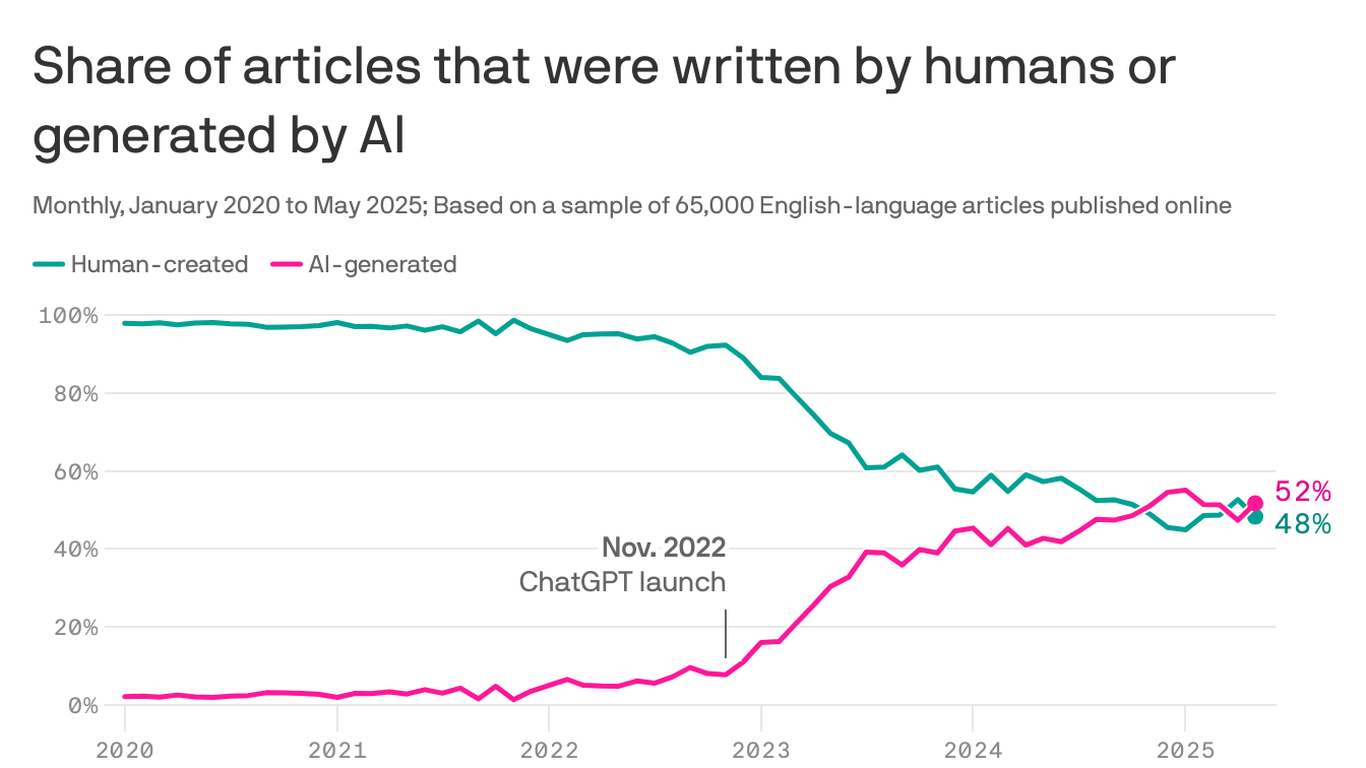
Exclusive: The web is still mostly written by humans, study finds
Site: Axios
New data shows AI-written content is plateauing — and doesn't perform well in search.
-
How AI Made Me 33% More Productive Added: Oct 15, 2025
How AI Made Me 33% More Productive
Taking the grunt work out of writing
-
Clash of the Conservatives: Is the Populist Project Worthwhile?
Site: YouTube
Is the populist project worthwhile, and has President Trump fulfilled his promise as its avatar? Hear Richard Hanania, a former right-wing figure, Trump enth...

-
Google’s AI video generator is getting better editing and more audio | The Verge Added: Oct 15, 2025
Google’s AI video generator is getting better editing and more audio
Site: The Verge
You can fix lighting and add shadows in AI-generated videos made with Flow.
Google is making videos created with the AI filmmaking tool Flow even more realistic — and harder to identify as AI-generated at first glance. The company announced Wednesday that users can add in and change the shadows and lighting of their AI videos. The expanded editing features in Flow are tied to the Veo 3.1 update, also announced on Wednesday, which Google says does a better job of making a video based on the images submitted as a prompt. Flow users will also be able to generate videos with audio using several of the tool’s new features. Users can make a video with audio based on three reference images that the company calls “Ingredients to Video.” Another feature, called “Frames to Video,” creates a video that bridges a starting image with an ending image, with accompanying audio. The “Scene Extension” feature lets you take the final second of a clip and add on additional generated video up to a minute in length, also with generated audio. [Media: https://youtu.be/B78BJuPxmBU?si=bube0ILNKqeZ1vgr] Veo 3.1 costs the same as Veo 3, is available as part of a “paid preview” through Gemini API to developers, and is enabled in the Gemini app. According to Google, Flow users will soon be able to remove “anything” from a video — the tool will restructure the background and scene to make “it look as though the object was never there.”

-
 Just Starting Out in Bash Scripting? Here's How to Do It Right
Added: Oct 15, 2025
Just Starting Out in Bash Scripting? Here's How to Do It Right
Added: Oct 15, 2025Just Starting Out in Bash Scripting? Here's How to Do It Right
Site: How-To Geek
Best practice makes perfect.

-
Police Arrest Mad Scientist
Added: Oct 15, 2025
Police Arrest Mad Scientist
Site: Futurism
Halloween came early this year for a man in the UK who landed in hot water after trying to collect "every element on the periodic table."

-
Lawyer Gets Caught Using AI in Court, Responds in the Worst Possible Way
Added: Oct 15, 2025
Lawyer Gets Caught Using AI in Court, Responds in the Worst Possible Way
Site: Futurism
Even after being caught, the embattled lawyer, at first, refused to admit that he used AI in his court documents.

-
 Two Black Holes Locked in a Death Spiral Imaged in Stunning First : ScienceAlert
Added: Oct 15, 2025
Two Black Holes Locked in a Death Spiral Imaged in Stunning First : ScienceAlert
Added: Oct 15, 2025Two Black Holes Locked in a Death Spiral Imaged in Stunning First
Site: ScienceAlert
The complex dance of two black holes locked in a doomed orbit has been revealed in a first-of-its-kind direct radio image.